

When The Hershey Company announced Reese's Pieces with Chocolate Cookie on July 8, the headline sounded harmless: a crunchy new candy, the first new Reese's Pieces flavor in the United States in a decade, arriving in stores nationwide on July 17 and online July 25. The product is built for texture, portability, and impulse. But the launch lands at a more complicated moment for candy than the press release suggests.
Food dyes are under federal pressure. Heavy metals in chocolate remain unresolved. Allergen labeling is sharper, but still hard for families to interpret quickly. Ultra-processed foods are being scrutinized by researchers, regulators, and state lawmakers. A new candy is no longer just a new candy. It’s a case study in how little the public can see.
At a grocery store, the decision will take seconds. A parent sees Reese's, sees "chocolate cookie," sees a familiar orange-and-yellow brand language, and tosses the pouch into a cart. The deeper questions are invisible: Which color additives are used? Is the chocolate component connected to cocoa supply chains that have been scrutinized for lead and cadmium? What allergens are present beyond peanuts? How does a shopper compare this product with a child's food allergy plan, a clinician's advice, or a household trying to cut back on ultra-processed snacks?
The answer should not require a chemistry degree.
The Product Launch Meets a Regulatory Clock
Hershey's new Reese's Pieces with Chocolate Cookie arrives just as U.S. food-color policy is moving faster than it has in years. In January 2025, the FDA revoked authorization for FD&C Red No. 3 in foods and dietary supplements, with food manufacturers facing a January 2027 compliance deadline. In April 2025, U.S. Department of Health and Human Services (HHS) and FDA announced a broader initiative to phase out petroleum-based synthetic dyes from the food supply, and the FDA is now publicly tracking industry pledges to remove them.
That matters because candy is one of the categories most dependent on visual identity. Color is not decoration in confectionery. It is part of the product architecture, a cue for flavor, brand recognition, and repeat purchase. The ethical question is not whether candy should exist. It is whether ingredient disclosure has kept pace with how these products are engineered, marketed, and consumed.
A 2025 Guardian report captured the political acceleration around food dyes, noting that multiple U.S. states were moving to restrict the additives amid concerns about children's health. The stronger source underlying the debate is the FDA’s own action on Red No. 3, and its newer dye phase-out effort, which confirms that color additives once treated as routine are now central to food-policy urgency.
The public should not confuse regulatory movement with settled science. Color additive risk varies by compound, exposure, and population. But regulation is revealing something important: the burden has shifted. Companies can no longer assume that compliance alone will satisfy consumers who want to know why an additive is there, whether there is a safer alternative, and how the ingredient fits into a broader diet.
The Chocolate Question Hershey Cannot Escape
The chocolate-cookie center also introduces another unresolved investigation: heavy metals in chocolate. Consumer Reports 2023 testing found concerning levels of lead and cadmium in some chocolate products and urged Hershey to reduce those contaminants in its chocolate portfolio. One Hershey-owned Scharffen Berger Chocolate Maker bar was among the products CR highlighted for cadmium. CR's work was not a regulatory enforcement action, but it raised a legitimate public health question that regulators have also recognized: cocoa can carry contaminants through soil, processing, and supply chains.
This does not mean Reese's Pieces with Chocolate Cookie is unsafe. It does mean that "chocolate" is not a simple ingredient category. It can be a supply-chain story, a soil story, a sourcing story, and a testing story.
For a parent, the practical problem is cumulative exposure. A child may eat candy, cereal, packaged snacks, and chocolate desserts across the same week. Every single serving may seem trivial. But public-health risk often lives in repetition, not drama. Ingredient transparency has to account for the pattern, not just the package.
Ultra-Processed Food: Useful Warning, Imperfect Label
The new Reese's flavor also sits inside the much larger debate over ultra-processed foods. A 2024 BMJ umbrella review found associations between exposure to ultra-processed foods and a wide range of adverse health outcomes, while acknowledging the limits of observational evidence. Another 2024 BMJ article warned that the category is heterogeneous and that researchers still need to separate the effects of processing from nutrient profile, energy density, sugar, salt, fat, and other factors.
That nuance matters. Candy is not controversial because it is “processed.” Chocolate, peanut butter, and cookies all require processing. The concern is the modern stack: refined carbohydrates, added sugars, fats, color systems, emulsifiers, flavorings, shelf-stability design, brand-driven portion formats, and marketing that encourages frequent consumption.
Nature Reviews Gastroenterology & Hepatology reached a similar point in 2024, arguing that evidence on ultra-processed foods and food additives is growing but still stronger in observational research than in human intervention studies. The responsible conclusion is not panic. It is better ingredient-level interpretation.
That is where the consumer information gap becomes obvious. The front of pack sells novelty. The back of pack lists ingredients. Neither explains what those ingredients mean for a specific person.
Allergen Transparency Is Better, But Not Yet Personalized
Reese's is a peanut brand. That part is obvious. But allergen risk is rarely limited to the obvious ingredient. Families managing food allergy have to read for peanuts, milk, wheat, soy, sesame, tree nuts, and cross-contact language, often while shopping under time pressure.
The FDA's implementation of the FASTER Act made sesame the ninth major U.S. food allergen as of January 1, 2023, joining milk, eggs, fish, crustacean shellfish, tree nuts, peanuts, wheat, and soybeans. CDC describes food allergy as a significant public-health issue in schools, estimating that about 1 in 13 children are affected and that two in five children with food allergies have been treated in an emergency department for a reaction.
A candy launch, then, is not one story for all shoppers. For one household, it is an occasional treat. For another, it is off-limits because of peanuts. For another, the question is wheat or milk. For a clinician, the relevant issue may be not prohibition, but dose, frequency, diet quality, and patient-specific risk.
Current labels are legal instruments. Consumers need decision instruments.
The Regulatory System Was Not Built for Ingredient Overload
The FDA explains that food additives are used to preserve safety and freshness, improve nutritional value, and affect taste or texture. It also distinguishes direct additives from indirect substances, such as food-contact materials. That framework is essential, but it was not designed for the way today’s consumers encounter food: thousands of packaged products, changing formulations, viral launches, retailer exclusives, and household-level health constraints.
STAT reported in 2024 that FDA was moving to strengthen review of chemicals added to food after years of pressure, including scrutiny of substances used for color, texture, and durability. The primary-source backdrop is FDA’s own guidance and chemical-review infrastructure, which reveal a system trying to keep pace while the marketplace keeps accelerating.
The gap is not only regulatory. It is informational.
A shopper can scan a candy bag and see calories, sugar, allergens, and ingredients. But the label does not answer the questions people increasingly ask:
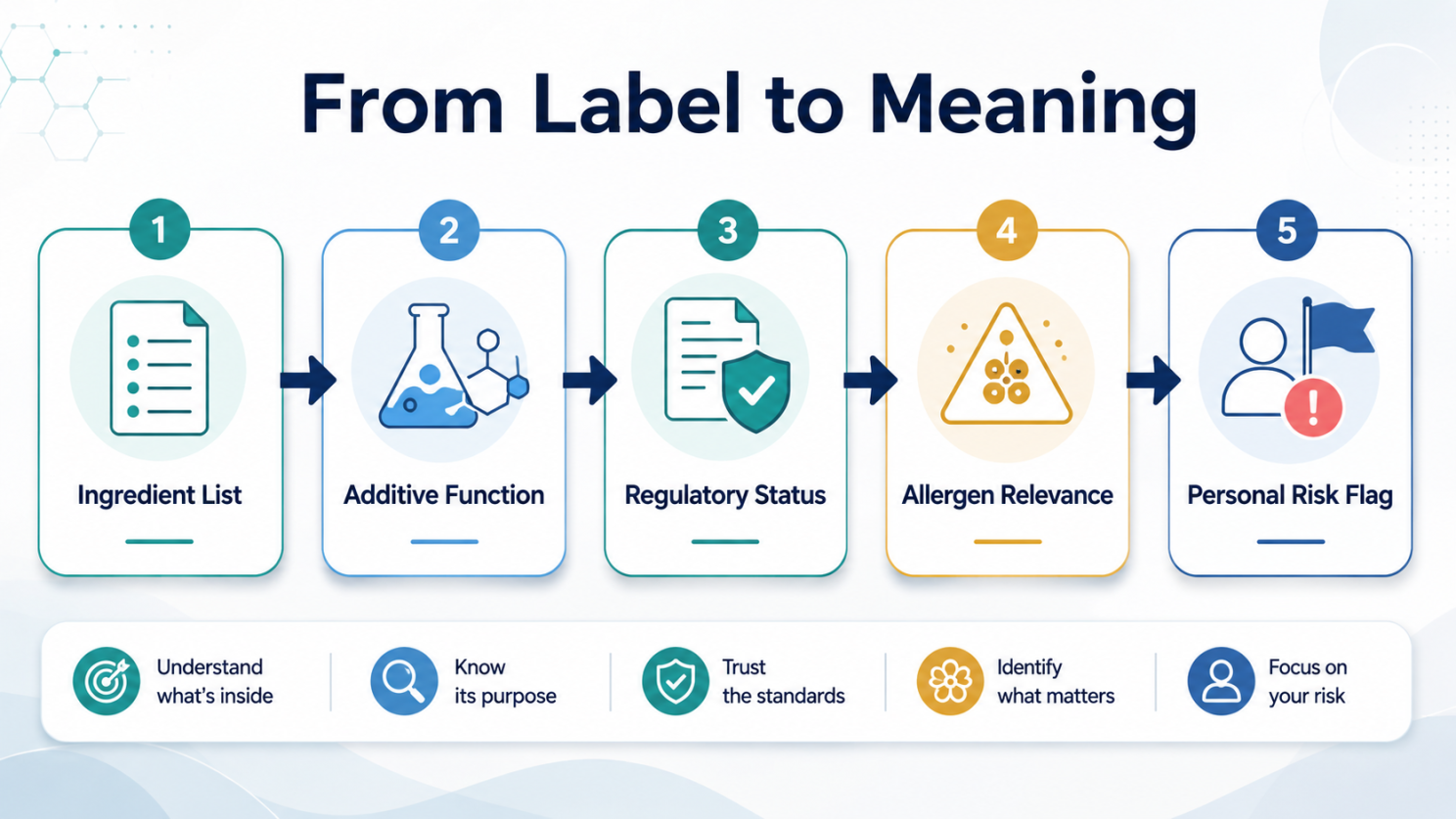
Is this additive under review? Is this ingredient restricted elsewhere? Is this product compatible with my child's allergy profile? Is the concern sugar, dye, an allergen, a contaminant, or the frequency of consumption? What changed since the last time I bought this brand?
This is the problem IngredientIQ is built around. Not to shame candy. Not to turn every snack into a moral referendum. To translate ingredient data, regulatory signals, allergen context, and health-personalization logic into something a person can use before purchase.
The Ethical Contrast: Compliance Versus Comprehension
Most large food companies operate within legal labeling rules. That is the floor. The modern consumer increasingly wants the ceiling: explainable ingredients, transparent tradeoffs, and alerts that reflect personal context.
IngredientIQ ’s position is strongest when stated narrowly. It cannot replace regulators. It cannot diagnose disease. It should not pretend that every additive is dangerous. Its value lies in making ingredient transparency computable and personal: a consumer-facing way to connect product labels with food-additive science, allergen needs, regulatory updates, and household preferences.
That distinction matters. The industry norm is disclosure by compliance. IngredientIQ's approach is disclosure by interpretation.
For a parent, that could mean identifying whether a product contains a flagged allergen or additive class. For a clinician, it could mean helping patients move from vague “eat less processed food” advice to product-level pattern recognition. For a journalist, it could mean tracing how a reformulation, dye pledge, or contaminant concern connects to primary regulatory documents rather than brand messaging.
What the Reese's Launch Really Reveals
Reese's Pieces with Chocolate Cookie will likely be judged by taste, crunch, and nostalgia. That is the surface story. The deeper story is that the candy aisle has become a regulatory stress test.
The FDA is phasing out certain uses of synthetic dyes. Consumer Reports has kept pressure on chocolate manufacturers over lead and cadmium. Researchers continue to debate how best to measure the risk of ultra-processed foods. Food allergy rules have improved, but families still face rapid, high-consequence decisions.
No single candy launch caused these tensions. But it exposes them neatly. A familiar brand adds a new texture. A national rollout follows. Millions of shoppers see a bright pouch. The public is left to translate a technical label into a health decision.
That translation layer is now the missing public-interest infrastructure.
Consumers: before trying a new product, check more than calories. Look at allergens, color additives, cocoa or chocolate components, serving size, and how often similar snacks already appear in your household.
Health professionals: use product-level examples like this to move nutrition conversations from abstract warnings to practical ingredient literacy.
Journalists: follow the ingredient trail. Ask companies not only what is new, but what changed, which additives remain, what testing is done, and how reformulation decisions are documented.
For early access, ingredient alerts, and ongoing coverage of food-label investigations, follow IngredientIQ across its social platforms.
#IngredientTransparency #FoodAdditives #ReesesPieces #Hershey #FoodSafety #UltraProcessedFoods #FoodAllergies #FDA #CandyIndustry #ConsumerHealth #IngredientIQ #Decoded