
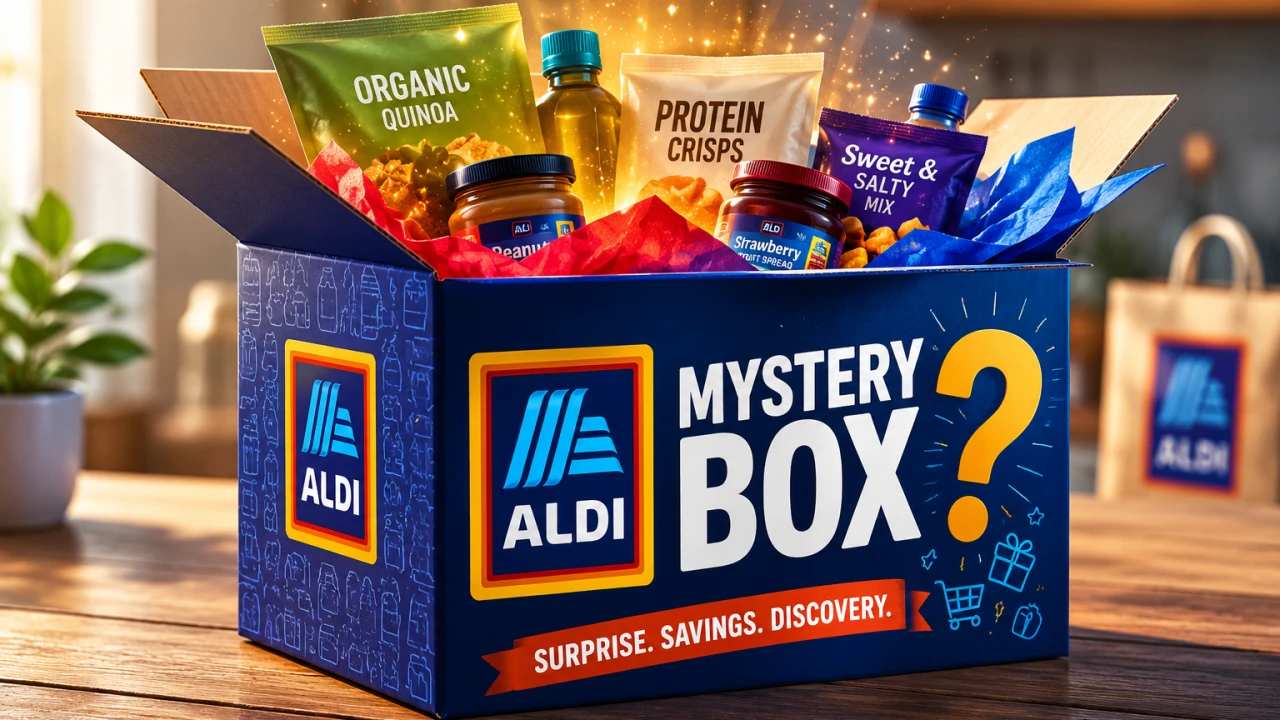
At noon Eastern on June 22, ALDI USA shoppers will be invited to do something that sounds harmless, even fun: click fast, claim a free box, and wait for a surprise bundle of groceries to arrive at the door. For four days, Aldi says it will release a daily “Blind Box” themed around snacks, fiber, protein, and mystery items, tapping the same unboxing psychology that turned toys, cosmetics, and collectibles into social-media theater. The promotion is small. The signal is not. Grocery discovery is being redesigned around suspense, just as regulators are asking whether shoppers can actually understand what is in their food. (Business Insider)
The Giveaway
Aldi’s pitch is straightforward: shoppers visit the Aldi Blind Box site from June 22 through June 25 at 12 p.m. ET, select that day’s box, enter shipping information, and receive a free bundle while supplies last. The chain has framed the campaign as a way to help customers discover “fan-favorite” products, with daily themes announced through Instagram. (Business Insider)
The language is revealing. “Snack.” “Fiber.” “Protein.” “Mystery.” These aren’t just product categories. They’re signals. Snack implies pleasure. Fiber implies gut health. Protein implies control, fitness, and satiety. Mystery supplies the dopamine.
What the shopper doesn’t know, at the moment of desire, is the ingredient profile, additive load, allergen mix, sodium range, added sugar content, degree of processing, or whether the box fits a child with dye sensitivity, a patient managing diabetes, a consumer avoiding emulsifiers, or a household trying to cut ultra-processed foods.
That is the blind spot inside the blind box.
The Anecdote Hidden in the Promotion
Picture a parent in suburban Illinois, scrolling during lunch. Aldi is familiar. The box is free. The theme says “Fiber,” which feels reassuring, almost clinical. Maybe it contains beans, berries, oats, and vegetables. Maybe it contains fiber-fortified snacks with sweeteners, gums, flavors, and refined starches. Both can be true under the same broad consumer-facing promise.
That ambiguity matters because the American food label is already difficult to interpret in real time. The FDA has been moving toward front-of-package nutrition labeling precisely because many consumers struggle to convert back-panel facts into practical risk decisions while shopping. The agency’s proposed front-of-package rule would focus on saturated fat, sodium, and added sugars, nutrients strongly tied to diet-related disease. (U.S. Food and Drug Administration)
A mystery grocery box moves in the opposite direction. It asks the shopper to opt in before the label is visible.
Why “Protein” and “Fiber” Are Not Neutral Words
Protein and fiber are useful nutrients. They’re also powerful marketing shortcuts.
The FDA has been studying ultra-processed foods with NIH through a Nutrition Regulatory Science Program, including how consumption patterns may contribute to chronic disease. (U.S. Food and Drug Administration) NIH researchers also reported progress in developing metabolite-based tools to objectively estimate ultra-processed food intake, a sign that the science is moving beyond self-reported food diaries and toward biological measures. (National Institutes of Health (NIH))
The tension is simple: a product can be high in protein and still be highly processed. A snack can contain added fiber and still carry added sugars, sodium, flavor systems, emulsifiers, or color additives. A claim on the front does not explain the full formulation.
A 2024 BMJ umbrella review found consistent associations between greater exposure to ultra-processed foods and increased risk of multiple adverse health outcomes, particularly cardiometabolic, mental health, and mortality. The authors also noted limits in the evidence base, which is important. The point is not that every packaged snack is dangerous. The point is that food architecture now matters enough for regulators, researchers, and clinicians to try to define it more clearly. (BMJ)
The Additive Question Is No Longer Fringe
Aldi’s boxes may contain ordinary foods, and nothing in the promotion suggests a safety violation. But the broader marketplace is changing around them.
In 2025, the FDA revoked authorization for FD&C Red No. 3 in foods and ingested drugs, citing the Delaney Clause after studies showed cancer in male rats exposed to high levels. (U.S. Food and Drug Administration) FDA and HHS also announced steps to phase out petroleum-based synthetic dyes from the U.S. food supply, while the FDA began publicly tracking industry pledges to remove them. (U.S. Food and Drug Administration)
Consumer Reports and Yuka recently tested 40 popular food products and reported concerning levels of additives and contaminants in some widely consumed snacks, pressing the FDA to close oversight gaps. That investigation is not a verdict on Aldi. It is evidence of a larger accountability problem: shoppers often encounter risk-relevant ingredient information only after products are already normalized by price, placement, and branding. (Consumer Reports)
FDA has acknowledged the need for stronger post-market chemical review. In May 2026, the agency finalized a Food Chemical Safety post-market assessment program and launched reassessments of BHT and azodicarbonamide, signaling that chemicals already present in the food supply are now under renewed scrutiny. (U.S. Food and Drug Administration)
The Regulatory Clock Is Moving, Slowly
Traceability is another part of the story. FDA’s Food Traceability Rule is designed to require additional recordkeeping for certain high-risk foods, but enforcement has been pushed back. FDA states that the original compliance date was January 20, 2026, and that enforcement is not expected before July 20, 2028. (U.S. Food and Drug Administration)
That delay matters in a grocery culture increasingly built on bundles, limited drops, influencer discovery, and private-label velocity. The modern shopper doesn’t just need a Nutrition Facts panel. They need context: what the ingredient is, why it’s there, whether regulators disagree across countries, whether a child or patient should avoid it, and whether a “better-for-you” cue is doing more work than the evidence supports.
This is where IngredientIQ belongs in the story, not as a slogan, but as a corrective mechanism. The prevailing retail model asks consumers to trust the category: snack, protein, fiber, family favorite, limited edition. IngredientIQ starts at the ingredient level and then builds upward. It treats a grocery item as a chemical, nutritional, regulatory, and personal-health object, not merely a brand choice.
What a Transparent Blind Box Would Look Like
A more accountable version of Aldi’s campaign could still be fun. It would simply make the surprise compatible with informed consent.
A shopper could know before claiming a box whether it contains major allergens, synthetic dyes, high-sodium items, added sugars above a stated threshold, ultra-processed products, animal-derived ingredients, or ingredients under regulatory review. A parent could filter for dye-free products. A clinician could recommend “protein” boxes that distinguish whole-food protein from fortified snack formats. A journalist could compare the marketing theme with the ingredient reality.
That is the practical gap IngredientIQ is built to close: not telling people what to fear, but showing them what they’re actually choosing.
The Larger Question
Aldi's Blind Box may sell out in minutes. Most recipients will probably treat it as a pleasant grocery surprise. That’s fine.
But the promotion lands during a rare period when food regulation, chronic disease policy, additive scrutiny, and consumer confusion are converging. STAT recently reported that ultra-processed food researchers are calling for broader policy action, while FDA continues work on ultra-processed food definitions and labeling approaches. (STAT) The Guardian’s coverage of the BMJ umbrella review brought the same question into public view: how much processing should consumers be expected to decode on their own? (The Guardian)
A free box is not the scandal. The scandal is that surprise has become easier to deliver than transparency.
What Consumers Should Do
Before claiming any themed grocery box, treat the theme as marketing rather than nutrition guidance. When the package arrives, scan the ingredient lists, added sugars, sodium, allergens, dyes, emulsifiers, and serving sizes before folding the items into a child’s lunchbox or a medical diet. Follow IngredientIQ social platforms for early access to ingredient-level decoding, label updates, and ongoing coverage of food transparency.
What Health Professionals Should Watch
Protein and fiber claims deserve context. Ask whether the nutrient comes from whole foods or fortification, and whether the product's sodium, added sugar, additive profile, or processing level changes the clinical recommendation. IngredientIQ’s ingredient intelligence can help translate label complexity into patient-specific guidance without flattening all packaged foods into one risk category.
What Journalists Should Ask Next
How many boxes are available? What products are included? Are allergens disclosed before claim submission? Are any included products formulated with synthetic dyes, additives under review, high sodium content, or added sugar levels that are inconsistent with the theme? IngredientIQ will continue tracking how retail promotions intersect with regulatory science, health chemistry, and consumer accountability.
Editorial integrity note: this Decoded edition was reviewed against IngredientIQ's writing-quality checklist for varied structure, grounded language, and avoidance of synthetic-sounding patterns.
#IngredientTransparency #FoodAdditives #AldiFinds #UltraProcessedFoods #FoodLabeling #FDA #NutritionScience #GroceryShopping #ConsumerHealth #ProteinClaims #FiberClaims #IngredientIQ