
Decoded by
IngredientIQ White Paper • January 14 2026 “
From MyPlate to an Upside-Down Pyramid: The 2026 U.S. Dietary Guidelines, Real Food Rhetoric, and the Regulatory Crossroads of Nutrition Science
In January 2026, the U.S. government dropped a seismic revision to its federal dietary advice, the Dietary Guidelines for Americans, 2025–2030 — accompanied by a radical redesign of the food pyramid. Hailed by Health and Human Services Secretary Robert F. Kennedy Jr. as “the most significant reset of federal nutrition policy in history,” this update flips decades of conventional dietary guidance on its head, placing whole foods, protein,and fats above grains and refined carbohydrates in a new inverted pyramid. But beneath the political optics and bold slogans like “eat real food,” scientific and regulatory tensions are emerging that spotlight deeper questions about evidence, public health, and ingredient transparency. (USDA)
A Real-World Snapshot: The 2025–2030 Dietary Guidelines Roll-Out
On January 7, 2026, the U.S. Departments of Health and Human Services (HHS) and Agriculture (USDA) jointly released the Dietary Guidelines for Americans, 2025–2030, asserting a sharp pivot back to nutrient-dense whole foods and wide-ranging reductions in added sugars and highly processed products. Federal officials framed this as a response to chronic diet-related disease, with nearly 70% of adults overweight or obese and diet-linked conditions like prediabetes rising among adolescents. (USDA)
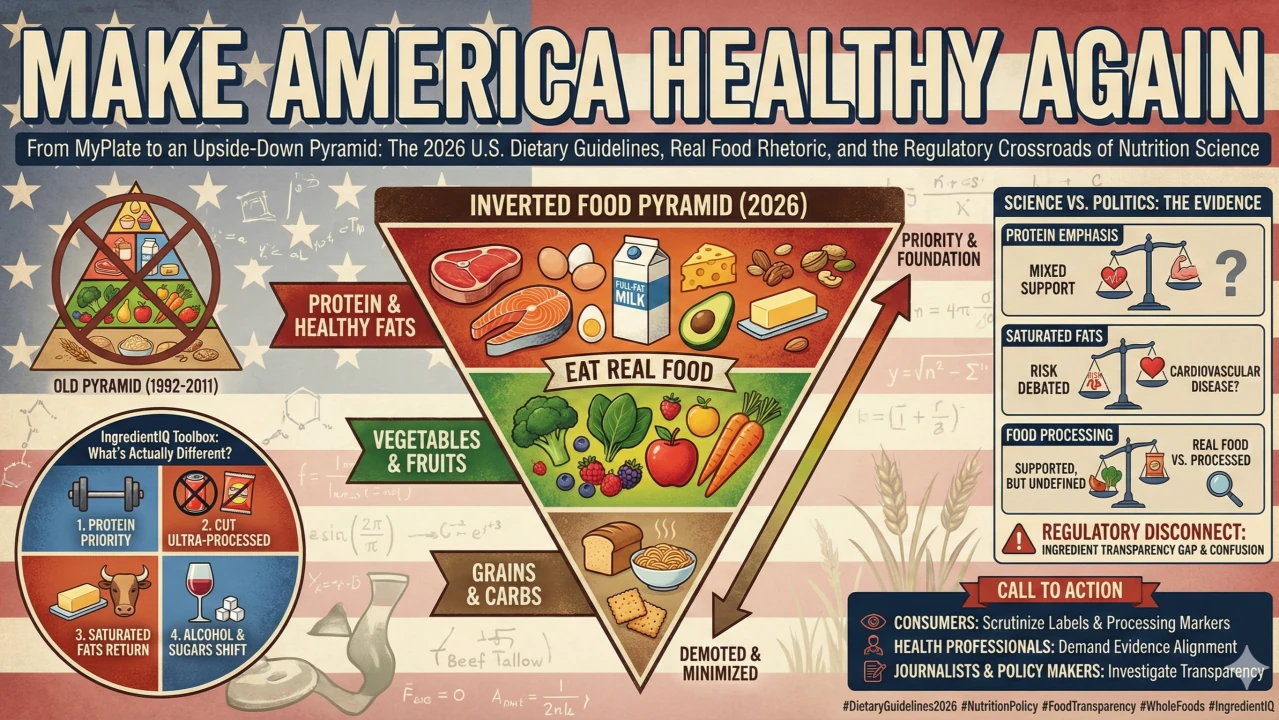
The visual centerpiece of this revision is a newly inverted food pyramid, reversing the USDA’s former MyPlate and older USDA pyramids that placed grains at their broad base. The flipped pyramid emphasizes proteins, dairy, vegetables, fruits, and ‘healthy fats’ near the widest, most recommended tier, while whole grains and carbohydrates sit nearer the narrow bottom. (factfeed)
This new pyramid has quickly become shorthand for the policy’s broader themes — real food, minimal processing, and unorthodox messaging on carbohydrates and fats.
IngredientIQ Toolbox: What's Actually Different?
1. Protein Gets Priority, Carbohydrates Get a Demotion
The 2025–2030 Guidelines elevate protein to a foundational role, recommending it in every meal and doubling earlier recommended intake levels — though scientific support for broad increases in protein intake across all demographics remains mixed in peer-reviewed literature. (Good Housekeeping)
Why this matters:
- Historically, federal guidance has balanced food groups and emphasized carbohydrate sources like whole grains.
- A renewed focus on proteins, especially animal proteins, shifts agricultural and economic incentives.
2. Added Sugars and Ultra-Processed Foods Under the Microscope
For the first time, federal guidance explicitly calls out highly processed foods and urges dramatic cuts in added sugars, aligning more closely with emerging public health research that links ultra-processed products to chronic disease and metabolic syndrome. (STAT)
IngredientIQ Insight:
True ultra-processed foods aren't consistently defined in federal guidance, limiting regulatory clarity for labeling and education — a crucial gap, given that Americans consume more than half their daily calories from ultra-processed sources.
3. Saturated Fats and Full-Fat Dairy Return to Favor
The new guidance embraces full-fat dairy and traditional fats like butter and beef tallow under the banner of “healthy fats,” with Kennedy declaring an end to the so-called “war on saturated fat.” Meanwhile, longstanding limits on saturated fats (typically ≤10% of calories) persist in background guidance, creating a disconnect between the pyramid’s messaging and its technical text. (The Nutrition Source)
Why this matters:
- Saturated fats remain a contentious area in nutrition science, with mixed evidence on risk profiles for cardiovascular disease.
- Federal guidance that embraces saturated fats without reconciling these conflicts could confuse consumers and clinicians alike.
4. Alcohol and Sugars: Less Is Still Better, But Recommendations Shift
The guidelines maintain the push to limit added sugars and update alcohol guidance to be more generalized, without specific daily drink limits, emphasizing reduced consumption for health. (Healthline)
Science vs. Politics: What the Evidence Says
Despite bold proclamations, the scientific basis for some elements of the updated pyramid is debated among nutrition researchers:
- Protein emphasis: While protein is essential, evidence does not universally support increased intake for all Americans, especially in the absence of tailored medical needs. Research suggests moderation and balance — rather than “more is better” — align better with outcomes in heart and metabolic health.
- Saturated fats: Longstanding studies link high intakes to increased risk of cardiovascular disease; the resurgence of full-fat advice contradicts much of this body of evidence.
- Food processing: Emerging research supports the reduction of ultra-processed foods, but clear public definitions and regulatory standards are lacking, a transparency shortfall that IngredientIQ flags as a public health priority.
The disconnect between the Scientific Report crafted by the Dietary Guidelines Advisory Committee (which leaned toward plant-focused patterns) and the final political guidance underscores the influence of non-scientific forces in public nutrition policy. (Dietary Guidelines)
Old Pyramid vs. New Pyramid: A Regulatory Contrast
ComponentTraditional Pyramid (1992–2011)New Inverted Pyramid (2026)Base Food Group: Grains and carbohydratesProteins and whole foodsGraphic PurposeSimple servings guidanceNutrient density + policy signalEmphasis on Processing: Moderate, Strong call to reduce ultra-processed foodsSaturated Fat & Dairy: Limited, Elevated acceptance
This shift not only alters educational messaging but also has policy implications for federal programs such as school lunch standards, SNAP nutrition education, and national health promotion campaigns. (Health.gov)
IngredientIQ Takeaways: What This Means for Consumers and Policy
- Consumers should scrutinize labels not just for fat or sodium, but for processing markers and additives that contribute to chronic disease risk.
- Regulators must define ultra-processed foods and harmonize dietary guidance with up-to-date science to avoid public confusion.
- Ingredient transparency is now mission-critical as dietary policy navigates among politics, industry pressures, and public health science.
The 2026 dietary guidelines represent a pivot from nutrient-centric plate models to a narrative of whole foods and minimal processing. Yet without clear definitions, strong evidence consensus, and ingredient-level transparency standards, Americans may be left with more confusion than clarity.
Call to Action
Consumers:
Learn how the new guidelines affect your food choices and budgets. Health Professionals: Demand evidence alignment and clarity in federal nutrition standards. Journalists & Policy Makers: Investigate how ingredient transparency can anchor future guidelines in science — not slogans.
#DietaryGuidelines2026 #NutritionPolicy #FoodTransparency #WholeFoods #ChronicDiseasePrevention #UltraProcessed #Protein #SaturatedFatDebate #PublicHealthNutrition #IngredientIQ #RegulatoryScience
Sources: USDA and HHS press releases, federal nutrition policy documents, public health coverage from STAT, Healthline, GoodHousekeeping, The Guardian, and nutrition science analysis. (USDA)