
Published by IngredientIQ
A mother opens a bag of chips, intending to eat a handful. Twenty minutes later, the bag is empty.
A teenager finishes a fast-food meal and immediately searches the pantry for dessert.
An executive promises to stop buying frozen pizzas after a routine cholesterol test, only to find another box in the shopping cart the following week.
For decades, these experiences were dismissed as failures of willpower.
Increasingly, scientists are asking a different question:
What if the food itself is part of the problem?
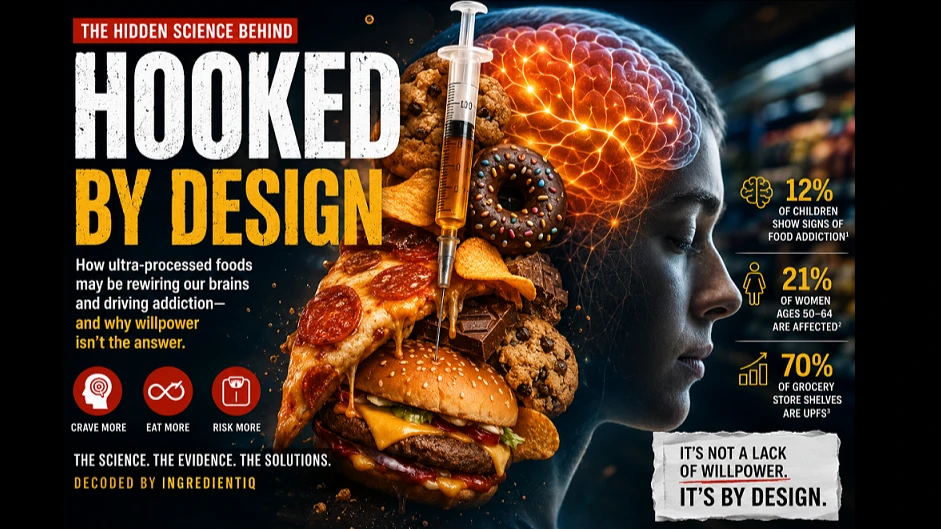
A growing body of research suggests that some ultra-processed foods (UPFs) may trigger behaviors that closely resemble addiction, not metaphorically, but according to the same clinical criteria used to assess substance-use disorders. The implications reach far beyond obesity. They challenge assumptions about personal responsibility, food regulation, product design, and the future of public health. (Nature)
The CNN Investigation That Captured a Larger Scientific Shift
This week, CNN highlighted emerging evidence that addiction to ultra-processed foods is both measurable and increasing. The report centered on work by University of Michigan psychologist Dr. Ashley Gearhardt, creator of the Yale Food Addiction Scale, one of the most widely used research tools for identifying addictive-like eating behaviors. (Michigan News)
The article described a food environment dominated by products engineered with precise combinations of:
- Refined starches
- Added sugars
- Salt
- Industrial fats
- Flavor enhancers
- Texture modifiers
The result is not simply a tastier product.
It is a product optimized to create intense reward signals while minimizing satiety.
That distinction matters.
Humans evolved to seek scarce sources of fat, sugar, and sodium. Modern food manufacturing concentrates those rewards into combinations rarely found in nature, then makes them available 24 hours a day at low cost and massive scale. (Nature)
Addiction Is No Longer a Fringe Theory
For years, the idea of "food addiction" sat on the margins of nutrition science.
That is changing.
In 2025, a major commentary in Nature Medicine argued that evidence linking ultra-processed foods to addiction-like responses has become too substantial to ignore. Researchers reviewed nearly 300 studies spanning 36 countries and concluded that certain UPFs can trigger cravings, loss of control, persistent consumption despite harm, and withdrawal-like symptoms, all hallmark features of addiction. (Nature)
The timing is notable.
Congressional hearings have examined the role of addictive food formulations in childhood chronic disease. A lawsuit filed in Philadelphia alleges that major food companies intentionally designed and marketed addictive products to children. While these claims remain contested, the legal framing itself reflects a dramatic shift in public discourse. (Nature)
Which Foods Trigger the Strongest Addictive Response?
The answer isn't simply "sugar."
That may be one of the most important findings emerging from current research.
Gearhardt's team found that the foods most consistently rated as addictive shared a specific nutritional profile:
Characteristic Common Examples High refined carbohydrates Pizza crust, chips, crackers, pastries High fat contentFast food, snack foods, frozen meals High energy density Cookies, candy, packaged dessertsRapid digestionWhite flour products, processed starches
Interestingly, many foods frequently blamed in public debates contain little added sugar at all.
Potato chips, crackers, and refined-flour products can be rapidly converted to glucose in the body, triggering reward responses similar to those of sugary foods. The combination of fast absorption and concentrated calories appears particularly influential. (Michigan News)
The Hidden Mechanism: Hyperpalatability
Food scientists have a term rarely discussed outside industry circles:
Hyperpalatability.
A food becomes hyperpalatable when ingredients are combined in ways that amplify reward beyond what naturally occurs.
Researchers have estimated that more than 70% of ultra-processed foods meet criteria for hyperpalatability. These products are designed to maximize pleasure, minimize chewing effort, accelerate consumption, and encourage repeat intake. (Wikipedia)
A naturally occurring apple contains fiber, water, texture, and natural sugars.
An industrially formulated snack cake contains refined flour, concentrated sweeteners, fats, emulsifiers, flavor systems, and texture modifiers carefully tuned for maximum reward.
Both contain carbohydrates.
Only one was engineered by a team of food scientists.
What the Clinical Trials Found
One of the strongest lines of evidence comes from tightly controlled feeding studies.
Participants were housed in research facilities where scientists controlled every meal, snack, activity level, and health measurement.
The findings were striking.
When participants consumed ultra-processed diets, they consistently consumed hundreds of additional calories per day compared with minimally processed diets, despite efforts to match meals for nutrient content. The difference often ranged from 500 to 1,000 calories per day.
The foods associated with the greatest overconsumption were both:
- Hyperpalatable
- Energy dense
This pattern suggests that calorie excess may not be solely a matter of personal choice. Product design itself may influence consumption. (Nature)
The Brain May Be Changing Too
Emerging neuroimaging research adds another layer.
A large 2025 brain-imaging study involving nearly 30,000 participants found associations between higher UPF consumption and structural differences in regions involved in feeding behavior, reward processing, and appetite regulation. Researchers cautioned that causation has not been established, but the findings raise important questions about whether repeated exposure may alter neural pathways related to eating behavior. (ScienceDaily)
If future research confirms these mechanisms, the debate may shift from:
"Why can't people control themselves?"
to
"Why are we repeatedly exposing populations to products capable of reshaping reward systems?"
Why Public Health Experts Are Concerned
The concern isn't limited to weight gain.
Recent research has linked higher consumption of ultra-processed foods with increased risks of:
- Type 2 diabetes
- Cardiovascular disease
- Obesity
- Cognitive decline
- Stroke
- Certain digestive cancers
Importantly, many studies observe measurable risk increases from relatively modest increases in UPF intake. Researchers continue to investigate causality, but the consistency across multiple health outcomes has intensified scrutiny from regulators and public health agencies worldwide. (Nature)
The Information Gap Consumers Face
Here is where the investigation becomes less about nutrition and more about transparency.
Most consumers can easily identify calories, fat grams, or protein content.
Far fewer can identify:
- Hyperpalatable formulations
- Rapidly digestible starch loads
- Reward-engineering ingredients
- Additive combinations associated with overeating
- Processing intensity
Current food labels reveal pieces of the story.
They rarely reveal the whole system.
A frozen pizza may display macronutrients. It does not disclose whether its formulation resembles products repeatedly associated with addictive-like eating behaviors.
That gap leaves consumers attempting to make informed choices with incomplete information.
IngredientIQ and the Emerging Transparency Standard
Most nutrition platforms focus on counting nutrients.
A growing number of researchers argue that nutrient counts alone may not adequately capture the health effects of modern food products.
IngredientIQ approaches the issue differently.
Rather than reducing foods to calories or macros, the platform evaluates ingredient composition, processing intensity, additive profiles, and emerging scientific evidence to help consumers understand what they are actually eating.
This distinction becomes increasingly relevant as evidence suggests that how a food is engineered may influence health outcomes as much as its nutrient totals.
The next frontier of nutrition may not be asking:
"How many calories are in this product?"
It may be asking:
"What was done to this product before it reached my plate?"
Questions Regulators Can't Ignore
If some ultra-processed foods satisfy clinical criteria associated with addiction-like behavior, several difficult questions follow:
- Should foods marketed to children face stricter formulation standards?
- Should hyperpalatable formulations receive greater regulatory scrutiny?
- Should food labels disclose processing intensity more clearly?
- Should addiction research influence dietary guidelines?
- How should AI-driven nutrition tools help consumers navigate increasingly complex food environments?
The answers remain unsettled.
The evidence, however, is becoming harder to dismiss.
For decades, the public conversation focused on individual responsibility.
The next decade may focus on product responsibility.
And that would represent a profound shift in how society understands food.
For Consumers
Scan beyond calories. Examine ingredients, processing levels, and formulation patterns. Follow IngredientIQ for ongoing investigations into the products shaping modern diets.
For Health Professionals
Monitor emerging evidence on ultra-processed food addiction and consider how processing intensity may influence patient outcomes beyond traditional nutrient metrics.
For Journalists
The intersection of food engineering, behavioral science, regulatory policy, and chronic disease remains one of the most underreported public health stories of the decade.
Follow IngredientIQ's channels for continuing coverage, source documents, regulatory updates, and evidence reviews.
#UltraProcessedFoods #FoodAddiction #FoodTransparency #IngredientIQ #NutritionScience #PublicHealth #FoodPolicy #MetabolicHealth #ChronicDisease #FoodIndustry #ConsumerHealth #PreventiveMedicine