

Decoded by IngredientIQ
A familiar root vegetable is being repackaged as a cardiovascular intervention.
Once concentrated largely in endurance-sport circles, beetroot now appears in capsules, chews, powdered drink mixes, “nitric oxide boosters,” blood-pressure formulas, recovery products, and men's health supplements. Retail data supplied by SPINS illustrate the speed of the shift: in the 52 weeks ending October 6, 2024, U.S. mainstream-channel sales of beetroot products positioned for cardiovascular health rose 161.3 percent, reaching nearly $46.8 million. In the natural channel, sales climbed 293.7 percent.
The commercial story is easy to understand. Beets contain nitrate. The body can convert nitrate into nitric oxide, a signaling molecule that relaxes blood vessels and influences circulation. Better blood flow sounds useful to a cyclist trying to hold pace, an older adult monitoring blood pressure, or a consumer worried about heart health.
The scientific story is more complicated.
Recent research supports some carefully defined benefits, particularly for exercise performance and short-term vascular function. But products sold under the same ingredient name may deliver markedly different nitrate exposures. A jar labeled “beetroot powder” may tell a shopper almost nothing about the dose most closely connected to the desired physiological effect.
That gap, between ingredient recognition and ingredient verification, is where the beetroot boom becomes an accountability story.
A supplement crosses the aisle
For years, beetroot juice belonged to the world of time trials, running clubs and professional sports. Athletes often consumed concentrated nitrate shots before competition, hoping that dietary nitrate would reduce the oxygen cost of exercise or improve tolerance to high-intensity exercise.
Now the same mechanism is being translated into heart-health language.
The crossover is commercially logical. Nitric oxide helps regulate vascular tone, and reduced nitric oxide availability is associated with endothelial dysfunction. A consumer doesn’t need a chemistry degree to grasp the pitch: nitrate becomes nitric oxide, nitric oxide widens vessels, and wider vessels may improve blood flow.
A 2026 systematic review and meta-analysis by Cai and colleagues examined beetroot juice across aerobic and anaerobic performance outcomes. The analysis reported benefits on selected measures, including maximal oxygen uptake and some high-intensity performance endpoints, while also underscoring the variability introduced by different doses, study populations, exercise protocols, and intervention lengths.
That qualification matters. “Improves athletic performance” sounds like a universal claim. The literature is not.
A recreational runner may respond differently from an elite athlete. A single pre-event dose may not resemble daily supplementation. A nitrate-standardized juice shot cannot automatically be treated as equivalent to an unspecified scoop of beet powder.
The ingredient is the same. The exposure may not be.
What nitrate actually does
Dietary nitrate is absorbed into the bloodstream, concentrated in the salivary glands, and secreted into the mouth. Certain oral bacteria reduce nitrate to nitrite. After swallowing, nitrite can be converted into nitric oxide, particularly under low-oxygen and acidic conditions.
This nitrate-nitrite-nitric oxide pathway helps explain why beetroot has attracted interest in both exercise physiology and cardiovascular research. Recent scientific reviews describe effects on vascular signaling, mitochondrial efficiency, muscle function and blood-flow regulation, but they also emphasize that outcomes depend on nitrate dose, oral and gut microbiota, health status, training level and background diet.
The mouth is not a passive delivery tube in this process. It is part of the metabolic machinery.
Research has found that disrupting nitrate-reducing oral bacteria can weaken nitrate conversion. A recent review concluded that the composition of the oral microbiome may influence nitric oxide availability, endothelial response, and blood pressure outcomes. Earlier controlled research also found that antibacterial mouthwash could blunt oral nitrate reduction and alter circulating nitrate-related markers.
That creates an oddly practical question rarely addressed on supplement labels: could a consumer's antiseptic mouthwash routine change the effect of a beetroot product?
Possibly. Yet the answer will depend on the rinse, its frequency of use, the individual's microbiome and the nitrate dose. This is not a reason to abandon oral hygiene. It is evidence that a supplement's effect cannot always be reduced to the milligrams printed on a package.
The heart-health evidence is promising, but narrower than the marketing
The strongest cardiovascular argument for beetroot concerns blood pressure and vascular function, not the prevention of heart attacks or strokes.
A meta-analysis of randomized trials in adults with hypertension found that nitrate derived from beetroot juice reduced clinic systolic blood pressure. The trials were generally short and varied in formulation, dose and design.
More recent studies continue to test beetroot in specific populations. A 12-week trial in postmenopausal women reported improvements in measures related to lower-limb vascular function and angiogenic activity after nitrate-rich beetroot extract supplementation. The findings were encouraging, but they involved surrogate markers rather than evidence that beetroot prevents cardiovascular events.
That distinction is easy to lose on a product page.
Blood pressure is a clinically meaningful risk factor. Endothelial function matters. Yet a temporary reduction in a blood pressure reading is not the same as demonstrating fewer strokes, heart attacks, hospitalizations, or deaths over several years.
Even blood-pressure effects may vary from person to person. In a 12-week investigation using beetroot juice that supplied 380 milligrams of nitrate, researchers observed substantial differences in how effectively participants converted nitrate into circulating nitrite.
One person's "nitric oxide booster" may be another person's expensive red drink.
The powder problem
Consumers often shop by ingredient name. Researchers usually study a defined intervention.
That mismatch is central to the beetroot market.
A clinical trial may specify the volume of juice, nitrate concentration, timing before exercise, duration of use and placebo composition. A commercial label may list “organic beetroot powder, 2,000 mg” without stating how much nitrate the serving contains.
Those numbers are not interchangeable.
Two grams of beetroot powder describes the weight of the plant material. It does not necessarily describe the amount of physiologically available nitrate. Growing conditions, soil composition, harvest time, processing, heat exposure and storage can all affect nitrate and antioxidant content.
A 2023 analysis of beetroot-based dietary supplements found considerable variation in nitrate, nitrite and antioxidant measurements among tested products. The researchers concluded that the composition of beetroot supplements required closer characterization, particularly because the biological activity of these products may depend on compounds that are not consistently declared on labels.
This raises a simple but consequential question: when a bottle says “beetroot,” what exactly has been standardized?
Sometimes the answer is nitrate. Often, it is not obvious.
A consumer trying to reproduce the results of a nitrate-standardized clinical trial may unknowingly purchase a powder containing a much smaller or more variable amount. Conversely, a person taking blood-pressure medication may use a concentrated product without realizing how much active nitrate it supplies.
The label can look precise while withholding the measurement that matters most.
What a useful beetroot label would disclose?
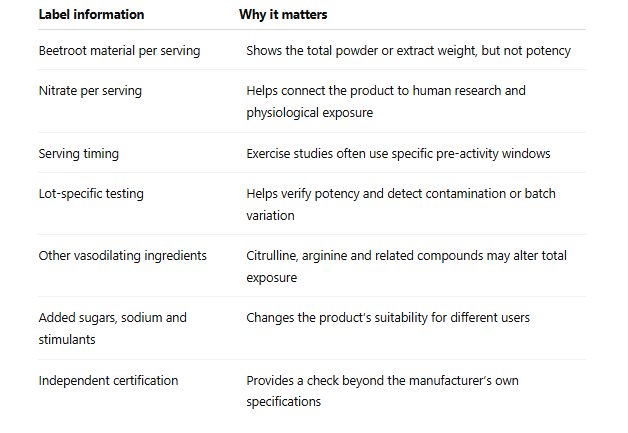
The category has a trust problem bigger than beets
There is no evidence that beetroot supplements as a class are broadly contaminated or deceptively labeled. But recent investigations across the supplement market show why a familiar plant image should not be mistaken for a quality guarantee.
In 2025, Consumer Reports tested 23 popular protein powders and ready-to-drink shakes. More than two-thirds contained more lead per serving than the organization's experts considered safe for daily intake, and several plant-based products showed particularly high levels. The investigation noted that the FDA does not routinely review, approve or test dietary supplements before sale.
A separate 2026 Consumer Reports investigation tested 20 fish-oil supplements for contaminants, oxidation and label accuracy. Most met the organization’s standards, but some showed signs of rancidity, and one fell below its stated omega-3 content.
These tests do not establish that beetroot products share the same defects. They reveal something more structural: shoppers frequently have to trust that an unverified label accurately represents potency, purity and stability.
Under U.S. law, the FDA does not approve dietary supplements for safety or effectiveness before they reach the market. In many cases, a company can legally introduce a product without first notifying the agency. Manufacturers are responsible for safety and truthful labeling, while regulators often act after products are sold or problems are detected.
A beetroot supplement can therefore sit beside a cardiovascular medication in someone’s kitchen while having passed through a fundamentally different evidence and oversight system.
The package may look medical. The regulatory pathway is not.
“Heart support” is not heart-disease treatment
Supplement companies are generally permitted to make structure-function claims, such as “supports circulation” or “promotes healthy blood pressure,” provided they follow applicable requirements. They cannot lawfully market an ordinary supplement as a proven treatment for hypertension or cardiovascular disease.
The language leaves room for implication.
A consumer may see a red heart icon, the words “clinically researched nitric oxide,” and a testimonial describing a lower blood-pressure reading. The product may never explicitly claim to treat hypertension, but the presentation can steer the consumer toward that conclusion.
The FDA warns that dietary supplements are not approved to treat or prevent disease and that biologically active ingredients can interact with medications or medical conditions.
For people taking antihypertensive drugs, nitrates, phosphodiesterase-5 inhibitors or multiple products intended to increase vasodilation, the relevant issue is not whether beetroot is “natural.” It is whether combined effects could contribute to dizziness, symptomatic low blood pressure or another avoidable problem.
Beetroot may also turn urine or stool pink or red, a usually harmless effect known as beeturia. Without warning, it can alarm consumers or complicate their interpretation of possible bleeding. Whole beets and some beet products may be relevant to people managing oxalate intake, kidney-stone risk or chronic kidney disease, although individual dietary restrictions should be based on clinical advice rather than sweeping avoidance.
A vegetable can be nutritious and pharmacologically active. Those ideas are not in conflict.
The dose hidden inside the claim
Many beetroot products are sold by powder weight because “3,000 mg beetroot” looks substantial. For nitric-oxide-related outcomes, however, nitrate content is usually more informative.
This produces a marketplace with three broad product types:
Whole-food-style powders
may provide fiber and a wider mixture of beet compounds, but nitrate content can be variable and relatively low.
Concentrated juices or shots
are commonly used in exercise studies and may provide a more meaningful nitrate dose, particularly when standardized.
Extracts standardized for nitrate
offer greater dosing precision but move the product further from the nutritional profile of whole beets.
None is automatically best. The right form depends on the intended use.
A consumer adding beet powder to a smoothie for flavor, color and general nutrition does not need to treat it like a pharmaceutical. A runner seeking a research-aligned pre-race nitrate dose needs more detail. A patient using it to affect blood pressure needs clinical context, medication review, and a product whose potency is actually known.
The problem begins when all three consumers are sold the same vague promise.
The performance effect is real enough to sell, small enough to exaggerate
The 2026 meta-analysis, provided with the original industry report, adds weight to the case that beetroot juice can improve selected measures of aerobic and anaerobic performance. Yet supplement marketing rarely communicates effect size as carefully as it communicates mechanism.
A measurable statistical improvement may translate into seconds, watts or marginal changes under controlled conditions. For a competitive athlete, a small gain can matter. For an occasional gym user, sleep, training consistency, hydration, carbohydrate availability and basic conditioning will usually overwhelm that margin.
Elite athletes also face a separate concern: supplement contamination with undeclared prohibited substances. Beetroot itself is not the issue. Multi-ingredient sports formulas and weak supply-chain controls can create risk. Third-party sport certification can reduce, though not eliminate, that exposure.
This is why "clinically studied ingredient” is an incomplete statement. The real questions are:
Was the finished product studied, or only a different beet preparation?
Does the serving provide the studied nitrate dose?
Was the trial conducted in people like the intended user?
Was the outcome meaningful, or merely measurable?
How long did the effect last?
A label that cannot answer those questions is borrowing authority from science rather than translating it.
Where IngredientIQ changes the inquiry
Most ingredient databases begin and end with a definition: beetroot contains nitrate; nitrate supports nitric oxide production.
That is useful, but not sufficient.
IngredientIQ's more defensible role is to separate an ingredient's identity from the evidence attached to a particular form, dose, and user. A beetroot powder, a nitrate-standardized extract and a concentrated juice should not collapse into one generic wellness rating.
A credible personalization system would examine the declared nitrate amount, other active ingredients, medication context, intended use, serving pattern and available testing. It would flag uncertainty rather than silently converting missing data into confidence.
For an endurance athlete, the key output might be whether a serving resembles those used in performance trials. For a person with treated hypertension, it might be a prompt to review additive blood-pressure effects. For someone with kidney disease, recurrent stones or unexplained red urine, the warning would be different.
This is not a diagnosis. It is evidence triage.
The ethical contrast is plain. Much of the supplement market benefits when consumers recognize an ingredient but do not inspect its specification. IngredientIQ becomes useful precisely when it refuses to treat recognition as proof.
A better standard for the beetroot boom
Beetroot does not need debunking. It needs to be decoded.
The ingredient has a plausible mechanism and a growing body of human research. Nitrate-rich preparations may improve selected exercise outcomes and can reduce blood pressure in some settings. The effects are not imaginary.
Neither are the limitations.
Many studies are short. Formulations differ. Individual nitrate conversion varies. Surrogate cardiovascular outcomes are more common than long-term clinical events. Commercial products may not disclose nitrate content. Multi-ingredient formulas make attribution difficult. And the U.S. supplement framework leaves much of the initial burden of verification with manufacturers and consumers.
The next stage of the market should not be driven by larger scoops, redder packaging or broader claims. It should be driven by better disclosure.
A product marketed for nitric oxide should state its nitrate dose. A product invoking clinical research should identify the relevant formulation and serving. Manufacturers should publish lot-level testing for potency, heavy metals and microbiological quality. Researchers should disclose commercial relationships and study finished products when branded claims are likely to follow.
Until that happens, beetroot’s most important number may not be the 161 percent sales increase.
It may be the missing milligrams of nitrate.
What can readers do now?
Consumers:
Check whether the label states nitrate content rather than beetroot weight alone. Do not replace prescribed blood-pressure treatment with a supplement. Review concentrated or multi-ingredient products with a pharmacist or clinician, particularly when using cardiovascular medications.
Health professionals:
Ask patients about powders, juice shots and “nitric oxide” blends, not only products they identify as supplements. Document the brand, serving size, nitrate declaration and concurrent vasodilating ingredients.
Journalists:
Separate studies of standardized nitrate preparations from stories about generic beetroot powder. Ask companies for certificates of analysis, lot-testing methods, adverse-event procedures and evidence supporting the exact finished-product dose.
Follow IngredientIQ 's social channels for early access to new Decoded investigations, ingredient alerts and updates on evidence, labeling and regulatory action.
#Beetroot #BeetrootSupplement #NitricOxide #HeartHealth #BloodPressure #SportsNutrition #DietarySupplements #IngredientTransparency #SupplementSafety #FoodChemistry #ConsumerHealth #IngredientIQ