
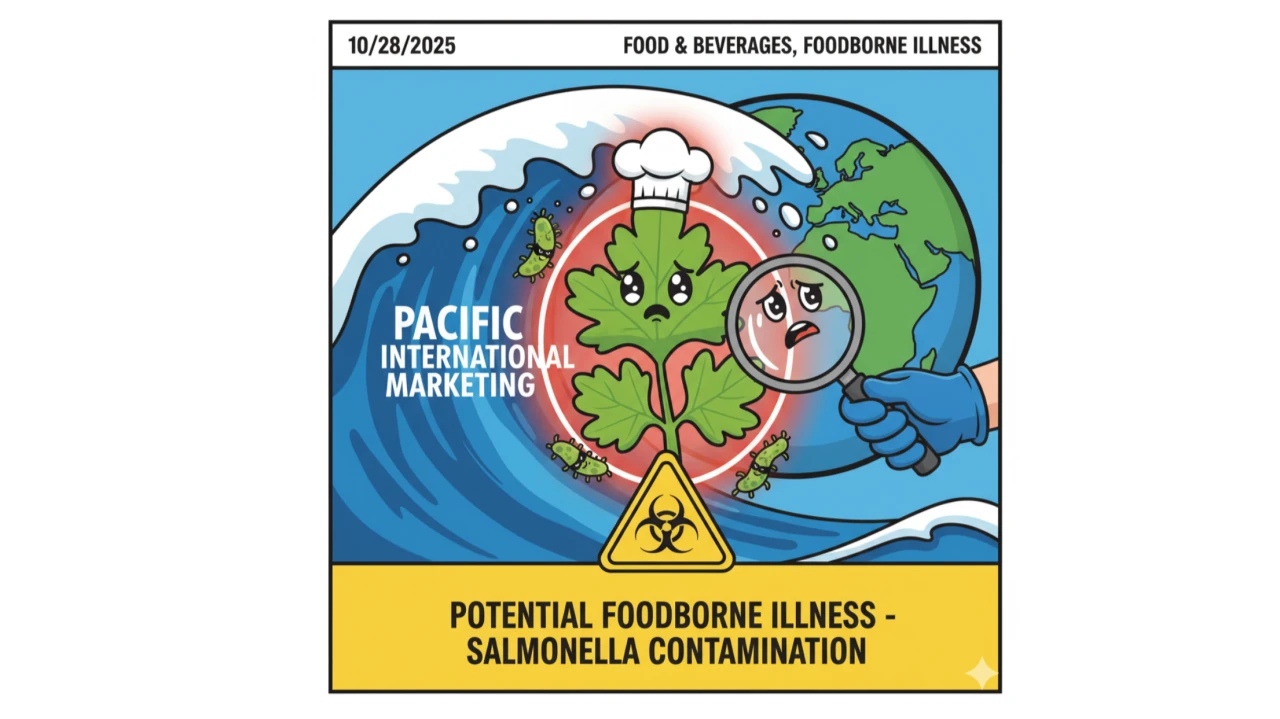
Decoded | Italian Parsley Recall, 10/28/2025
When a “simple garnish” isn’t simple, at all: What Pacific’s Italian parsley recall reveals about herb safety, agricultural water, and the traceability gap
On October 28, 2025, Pacific International Marketing recalled 474 cases of fresh Italian parsley for potential Salmonella contamination. Distribution spanned wholesalers in eight states, with specific UPCs on twist ties and bags. No illnesses were reported at the time of the notice, but the sample that triggered the action had tested positive on October 6, and the product’s 18-day shelf life meant much of it had already cycled through supply chains. U.S. Food and Drug Administration
A produce buyer for a Midwest meal-kit company told us she flagged a “mystery spike” in customer nausea reports in early October, then discovered the parsley she’d sourced had the same twist-tie UPC listed in Pacific’s recall. She’d moved on to pumpkin recipes and soups by then. The parsley had moved on too, often chopped into dressings or frozen in home kitchens. This is how leafy herbs quietly outpace our recall reflexes.
What happened, and why it matters now
Pacific’s notice is straightforward: fresh Italian parsley, bulk 30-count, 60-count, and 24-count bagged bunches, specific UPCs, shipped Sept 22–25 to AZ, CA, FL, GA, MI, MN, NV, and OH, recall posted Oct 28. The company reports no illnesses and is assisting FDA . For consumers, the practical risk window overlaps with the product’s stated 18-day shelf life from harvest, which ended October 10, unless product was frozen. U.S. Food and Drug Administration
Salmonella typically causes diarrhea, cramps, and fever. Symptoms usually begin 6 hours to 6 days after exposure and last 4–7 days, with severe outcomes more likely in young children, older adults, and immunocompromised people. CDC
Herbs are not new to outbreak files. In 2024, FDA and Centers for Disease Control and Prevention traced a multistate Salmonella Typhimurium outbreak to fresh organic basil, leading to a Trader Joe's recall and at least a dozen illnesses. U.S. Food and Drug Administration+1
The bigger pattern: fresh herbs keep showing up in surveillance
FDA’s multi-year sampling assignment for basil, cilantro, and parsley reported Salmonella in 0.8% of parsley samples tested, 0.9% of cilantro, and 2.8% of basil. The agency framed the finding plainly, pathogens may be present in fresh herbs, and urged industry to tighten compliance with the Produce Safety Rule and related FSMA rules. U.S. Food and Drug Administration+1
Regulators have also overhauled one of the weakest links, agricultural water. In May 2024, FDA finalized revisions to the Produce Safety Rule’s pre-harvest water requirements, shifting from rigid microbial testing toward a risk-assessment approach grounded in outbreak lessons, water system vulnerabilities, and real-world field conditions. That matters for low-growing herbs where splash, irrigation, or run-off can drive contamination. Federal Register
Compounding curiosity:
If water risks were modernized in 2024, why do herbs still recur in 2025 recalls? Are risk assessments implemented consistently across suppliers and seasons? How quickly does traceability data flow from field to buyer to consumer when the shelf life is measured in days?
What investigative reporting has surfaced
- KFF Health News flagged the basil-linked Salmonella outbreak in 2024, showing how a single supplier network can seed multistate illness clusters before consumers hear a word. Their coverage mirrored and linked to the FDA/CDC investigations, illustrating fast-moving cross-agency coordination and the lag between exposure and public notice. KFF Health News+1
- Regulator data, not headlines, showed the frequency: FDA’s herb sampling assignment quantified Salmonella prevalence across herb types and explicitly called for stronger industry compliance and preventive controls. That empirical baseline gives recalls like Pacific’s crucial context, moving the story from “one-off” to “recurring risk.” U.S. Food and Drug Administration
Risk framing for consumers and professionals
- Time matters. Illness often appears days after exposure, while recall notices arrive after confirmatory testing and trace-back. That delay can mask links in home kitchens and restaurants. CDC
- Exposure routes are predictable. Finely chopped herbs, uncooked sauces, garnish on ready-to-eat foods, and freezing leftovers extend the window. Pacific’s own language notes product could still be present even after freezing. U.S. Food and Drug Administration
- The policy lever is agricultural water and rapid traceability. FDA’s 2024 water rule revision and its herb sampling findings underscore where controls must tighten, from water source assessments to supplier verification and lot-level traceability that travels with twist ties and case labels, not just invoices. Federal Register+1
What to do today
- If you handled Pacific’s Italian parsley shipped Sept 22–25, discard any remaining product, check freezers for chopped or blanched parsley from that period, sanitize prep tools and surfaces, and contact the point of purchase for refunds. No illnesses have been reported in connection with this recall as of Oct 28. U.S. Food and Drug Administration
- If you have compatible symptoms, follow CDC guidance on Salmonella and seek care if severe or persistent, especially for higher-risk groups. CDC
Where current safeguards still wobble
- Speed of signal. Positive field or product tests can precede public warnings by days to weeks, while herbs cycle quickly through food service. Pacific’s sample was collected Oct 6; public notice posted Oct 28. U.S. Food and Drug Administration
- Fragmented data. Buyers often know UPCs and case labels, consumers do not. Retail signage rarely carries lot-linkable identifiers for fresh herbs. FDA’s herb sampling shows low but non-zero Salmonella prevalence, making missing identifiers consequential. U.S. Food and Drug Administration
- Water risk assessment is only as strong as implementation. The 2024 rule modernizes the framework, but uptake varies by farm, season, and region. Federal Register
How IngredientIQ closes the gap without the spin
IngredientIQ
is built for moments like this. We don’t sell parsley. We clarify it.
- Recall-aware personalization. We ingest FDA recall feeds and outbreak pages in real time, then map them to consumer-facing identifiers, from twist-tie UPCs to supplier aliases, so alerts reach the right households and kitchens. U.S. Food and Drug Administration
- Water-risk context, not just warnings. Our explainers pair any herb-related alert with the latest FDA water-rule requirements, so buyers and nutrition professionals can see what “good looks like,” and what to ask suppliers. Federal Register
- Evidence-first guidance. Symptom timelines and risk communications pull directly from CDC and FDA language, avoiding folklore and fear. CDC+1
- Traceability made human. We translate case labels and twist ties into plain language prompts in recipes and shop lists, which helps families and food-service teams actually act on recall details.
Ethical contrast:
Many platforms monetize engagement during alerts. IngredientIQ anchors on regulator-verified data, transparent citations, and clear conflict-of-interest policies. No ad targeting on recall content. Ever.
- Parents & home cooks: Freeze-and-forget herbs can outlast recall windows. If you froze parsley harvested late September, toss it if sourced from the listed states or wholesalers and you can’t rule out the recalled lot. Follow CDC symptom guidance if you’re ill. U.S. Food and Drug Administration+1
- Health professionals: Ask symptomatic patients about herb exposures in the preceding week, including garnishes and meal kits. Save packaging if available, and report suspected foodborne cases to local health departments. CDC
- Journalists: Start with the FDA company announcement, then pull the herb sampling report and 2024 water-rule final to frame systemic drivers. For historical continuity, pair with CDC’s 2024 basil outbreak investigation. U.S. Food and Drug Administration+3U.S. Food and Drug Administration+3U.S. Food and Drug Administration+3
The next obvious questions
- Are retailers surfacing lot-level identifiers for fresh herbs at point of sale or via digital receipts?
- How quickly can risk assessments under the 2024 agricultural water rule translate into season-specific supplier audits?
- Could standardized consumer-visible herb identifiers shorten the alert-to-action timeline during recalls?
Sources you can verify now
- FDA, Pacific International Marketing recall, company announcement and identifiers, Oct 28, 2025. U.S. Food and Drug Administration
- CDC, Salmonella symptoms and timeline. CDC
- FDA & CDC, 2024 fresh basil outbreak investigations. U.S. Food and Drug Administration+1
- FDA, FY17–21 Fresh Herbs sampling report with 2024 publication and prevalence data. U.S. Food and Drug Administration
- Federal Register, 2024 final rule revising pre-harvest agricultural water requirements. Federal Register
Call to action
- Consumers: Follow IngredientIQ dientIQ on social for verified, plain-English food alerts mapped to the products you actually buy.
- Health professionals: Join our early-access list for patient-facing recall modules grounded in FDA/CDC language.
- Journalists: Get embargoed explainers that connect single-day recalls to the underlying regulatory changes and surveillance data.
#parsleyrecall #foodsafety #salmonella #FDA #FSMA #ProduceSafetyRule #agriculturalwater #traceability #consumerhealth #publichealth #recallalert #IngredientIQ