
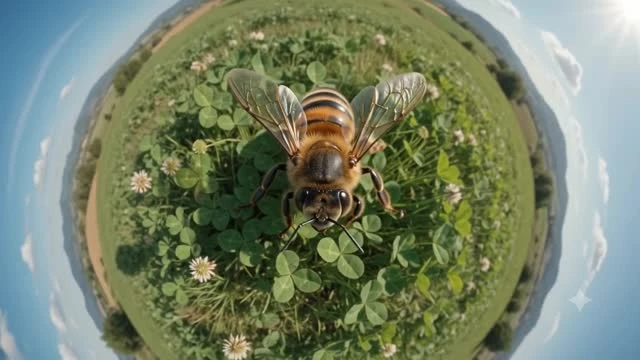
Decoded: The Bee Behind the Label
The harder question is why keeping that system running now requires replacing hundreds of thousands of failed colonies, treating parasites that are evolving resistance, and regulating chemicals whose risks don't appear anywhere on a food label.
On August 15, National Honey Bee Day arrives with an easy message: appreciate the bees.
The harder story begins inside the hive.
Earlier this month, the U.S. Department of Agriculture reported that commercial-scale operations entered 2026 with 2.81 million honey bee colonies, 6% more than a year earlier. At first glance, that sounds reassuring.
Then comes the number underneath it.
From January through March 2026, those same operations lost 454,890 colonies, equal to 16% of the colonies measured during the quarter. Beekeepers added 464,320 colonies during roughly the same period.
That is the strange arithmetic of modern American beekeeping: extraordinary losses can coexist with a stable, even rising, national colony count because beekeepers continually rebuild.
A population total can therefore hide considerable biological and economic churn.
And that matters far beyond honey.
USDA says pollination is responsible for more than $18 billion in added crop-production revenue in the United States. Honey bees are the country's primary commercial pollinator, working alongside thousands of native bee species and other insects that agriculture also depends upon.
So perhaps National Honey Bee Day deserves a different question in 2026.
Not simply: How important are bees?
We already know the answer.
The more revealing question is: What does it take to keep the pollination system functioning, and how much of that story can a consumer see in the food itself?
The winter when the trucks started arriving half-empty
The warning became difficult to ignore during the winter of 2024-25.
Commercial colonies were being hauled toward California, as they are every year, to pollinate the state's enormous almond crop. Beekeepers began opening trucks and finding losses far beyond what they considered normal.
A Guardian investigation reported that commercial operators participating in a Project Apis m. survey had lost more than 60% of their colonies on average, an unprecedented level that became visible as hives converged on California for almond pollination.
The eventual peer-reviewed analysis of beekeeper triage surveys confirmed just how unusual the season had been. Varroa mites were the cause most frequently cited by surveyed commercial beekeepers, followed by pesticides and pathogens. But the researchers also found that colony losses did not significantly differ between amitraz users and non-users, meaning resistance to one treatment couldn't, by itself, explain the entire event.
USDA scientists went looking inside the collapsed colonies.
They found high levels of deformed wing virus A and B and acute bee paralysis virus. The viruses are transmitted by Varroa destructor, a parasitic mite that has become one of the most consequential threats to managed honey bees. Researchers also detected signs that the mites were resistant to amitraz, one of beekeepers' most important chemical controls.
USDA's subsequent research reporting made the resistance problem even harder to dismiss. In 2024 sampling, more than 92% of 3,880 individual Varroa mites tested positive for an amitraz-resistance genotype. The agency cautions that the identified mutation doesn't explain every case of resistance, but the evidence suggests that a once-dependable control is losing ground.
A 2024 peer-reviewed study had already identified a new mutation in a Varroa octopamine receptor associated with amitraz resistance.
The chemistry is now locked in an evolutionary contest.
Beekeepers treat mites to save bees. The treatment selects for mites capable of surviving it. Resistant mites spread viruses. A weakened colony becomes more vulnerable to other pressures.
And those pressures rarely arrive one at a time.
There is no single "bee problem"
The temptation to find one villain has followed honey bee declines for years.
Pesticides.
Parasites.
Monoculture.
Climate change.
Poor nutrition.
Disease.
Commercial transportation.
Each explanation has evidence behind it. None adequately describes every colony in every landscape.
A 2024 peer-reviewed analysis described honey bee stressors as networks whose importance changes by crop and region, rather than a uniform chain of cause and effect.
Nutrition is part of that network. Honey bees require a steady supply of nutritionally adequate pollen, and intensive agricultural landscapes can produce periods when abundant blooms abruptly become food deserts. Research published in 2024 found that semi-natural habitat such as grasslands, forests and hedgerows can buffer those shortages and support honey bee survival.
Climate adds another layer. USDA's Climate Hubs identify extreme weather, habitat degradation, intensive agriculture and pesticide exposure among the pressures affecting both managed and native pollinators.
Then there are pesticides themselves.
Not only the chemicals used around bees, but chemicals used inside the hive to keep parasites from killing them.
That contradiction tells us something important about food-system risk. Chemicals can't always be divided neatly into "good" and "bad." Dose, exposure route, timing, target organism, persistence and resistance all matter.
A pesticide may protect a colony from a parasite while simultaneously creating evolutionary pressure that makes future control harder.
Context is the chemistry.
The pesticide argument didn't end with neonicotinoids
Few pesticide controversies illustrate the regulatory problem better than neonicotinoids.
These insecticides can be systemic, meaning the chemical can move through plant tissue. That raises a specific pollinator concern because exposure can occur through pollen and nectar rather than only through direct spraying. EPA's scientific framework therefore evaluates multiple exposure pathways and both individual-bee and colony-level effects.
Europe moved aggressively on several neonicotinoids years ago.
But the policy story kept moving.
In 2024, The Guardian reported that the United Kingdom's environmental watchdog was investigating repeated emergency authorizations of Cruiser SB, a sugar-beet seed treatment containing the neonicotinoid thiamethoxam. The approvals had been made despite concerns from scientific advisers about risks to pollinators.
The underlying government documents are more revealing than the headline.
The UK Office for Environmental Protection later found failures in the government's consideration of environmental obligations surrounding the 2023 and 2024 authorizations, including shortcomings involving assessments of risks to protected sites.
In January 2025, the UK government reversed course and denied another emergency authorization. Its formal reasoning acknowledged that adverse effects on honey bees and other pollinators could not be excluded and that limitations in the evidence prevented those risks from being quantified precisely.
That phrase matters: cannot be quantified with precision.
Regulation rarely happens in a world of perfect evidence. Regulators must decide what uncertainty means before all uncertainty has disappeared.
The United States has its own evolving framework. As of June 2026, EPA describes its pollinator risk-assessment guidance as a continuing effort to quantify pesticide effects on individual bees and colonies, including systemic exposures.
That doesn't mean every pesticide threatens bees equally.
It means the relevant question is considerably more specific than the word pesticide suggests.
Which molecule?
At what concentration?
Applied how?
During what part of the crop cycle?
How persistent is it?
Which pollinator is exposed?
What other stressors are already present?
These are ordinary questions in toxicology.
They are almost invisible in ordinary grocery shopping.
The ingredient list ends where the ecological story begins
Pick up an almond snack, blueberry yogurt, apple bar or jar of honey.
The package may tell you calories, sugar, allergens and ingredients. Depending on the product, it may offer claims about sourcing, organic production or sustainability.
What it generally cannot communicate is the network behind the ingredient.
The almond doesn't tell you that commercial pollination has become a major market of its own. USDA reports that pollination-service revenue has surpassed honey-production revenue for beekeepers since 2022, with the U.S. pollination-services market valued above $400 million and almond pollination commanding particularly high fees.
The ingredient list doesn't reveal whether a crop is heavily dependent on managed bees or supported by diverse native pollinators.
It doesn't tell you what pesticides may have been used under legally permitted agricultural practices.
And it certainly doesn't explain why a beekeeper might need one pesticide inside the hive while regulators are simultaneously evaluating a different pesticide used on the crop outside it.
None of this makes the ingredient unsafe to eat.
That distinction is critical.
Pollinator risk and human dietary risk are different scientific questions.
A chemical capable of harming an insect at a particular environmental exposure doesn't automatically present the same risk to a person consuming food. EPA evaluates pesticide residues in food under a human-health framework while separately assessing ecological effects, including risks to pollinators.
Confusing those endpoints produces bad science.
Ignoring either endpoint produces an incomplete food story.
Honey bees aren't the whole pollinator story
National Honey Bee Day can create one more misconception if we're not careful: that saving honey bees is equivalent to saving pollinators.
It isn't.
Honey bees are managed livestock in much of modern agriculture, extraordinarily useful livestock, but only one species within a much larger pollinator community.
USDA notes that more than 3,500 native bee species contribute to crop yields.
The broader conservation picture is troubling.
A recent North American assessment summarized by USDA researchers estimated that 21.8% of the 1,591 well-studied pollinating species assessed had elevated extinction risk. Among the bee species evaluated, the best estimate was 35.2%.
That creates an uncomfortable possibility.
We could become very good at replacing managed honey bee colonies while biological diversity around them continues to erode.
A beekeeper can split colonies, raise queens and rebuild inventory. A wild pollinator species disappearing from a landscape doesn't come with the same replacement mechanism.
So a national honey bee count isn't a biodiversity index.
Nor should a jar of honey become a proxy for ecological health.
What the 2026 numbers actually say
The newest USDA figures are neither a victory lap nor proof of an irreversible collapse.
They show a system under active management.
On January 1, 2026, large U.S. operations reported 2.81 million honey bee colonies, up from the previous year. During the first quarter, however, they lost nearly 455,000 colonies and added roughly 464,000.
Replacement is working.
But replacement has a cost.
Queens must be raised. Colonies must be split. Parasites must be monitored and treated. Hives are transported. Nutrition is managed. Pollination contracts have to absorb risk. Researchers must track resistance fast enough for treatment recommendations to remain useful.
The number of bees in the country is therefore only one measure of resilience.
A better question might be how much intervention is required to maintain that number.
That is where the National Honey Bee Day story becomes less sentimental and more consequential.
The transparency problem IngredientIQ is trying to solve
Ingredient transparency has traditionally meant answering a narrow question:
What's in this product?
Modern food systems increasingly require several more.
What is the ingredient?
Why is it used?
What does toxicology actually say about it?
How is it regulated?
Does hazard differ from real-world exposure?
What important environmental or supply-chain context sits outside the label?
Those questions shouldn't be collapsed into a red flag or a green checkmark.
IngredientIQ's useful role is precisely in that gap: connecting an ingredient name to the regulatory, chemical and scientific context needed to interpret it. The aim isn't to transform every environmental concern into a food-safety alarm. It's to prevent familiar packaging language from being mistaken for a complete account of how food is produced.
Honey bees are a useful test case.
The supermarket label tells us about the finished product.
The bee forces us to look upstream.
And once you look upstream, the tidy categories begin to disappear. Agricultural chemicals can protect crops and create ecological tradeoffs. Miticides can save colonies until resistance makes them less effective. Managed honey bees can remain numerically abundant while individual operations sustain punishing losses. A food can meet human residue standards while its production still raises a separate pollinator-risk question.
That isn't a reason for panic.
It's a reason for better information.
What to watch next
The most consequential bee-health story over the next several years may not be whether honey bee colonies suddenly disappear.
It may be whether the cost and biological complexity of maintaining them keeps rising.
USDA researchers are already pursuing alternative Varroa-control strategies as amitraz resistance spreads. In September 2025, EPA approved vadescana, an RNA-interference pesticide designed to target a gene required by Varroa mites while sparing honey bees and other non-target organisms according to the agency's assessment.
The science is moving in other directions too. USDA research programs are investigating resistant bee stocks, faster diagnostics, genomic tools and new disease interventions.
Meanwhile, regulators are still refining how pesticide risks to pollinators should be measured.
Which produces one final question.
If the tools used to protect pollinators are changing this quickly, shouldn't the way consumers understand the ingredients pollinators help produce evolve too?
National Honey Bee Day honors a remarkable insect.
The more meaningful tribute may be recognizing how much hidden infrastructure surrounds every flight from flower to flower.
Sometimes the smallest contributor does have the biggest impact.
But in 2026, the bee's story isn't small at all.
For consumers
When an ingredient raises a question, resist simple "good" or "bad" classifications. Look for evidence about dose, exposure, regulation and environmental context. Follow IngredientIQ for ingredient-level analysis that separates documented risk from assumptions and internet shorthand.
For health professionals
Environmental hazard, occupational exposure, ecological toxicity and dietary exposure aren't interchangeable endpoints. IngredientIQ's ongoing coverage is designed to make those distinctions easier to trace when patients encounter alarming claims about chemicals used in food production.
For journalists and researchers
The strongest stories often sit one layer beneath the press release. Follow the docket, risk assessment, regulatory opinion and primary paper. IngredientIQ will continue tracking those underlying sources and the gaps between what regulators know, what headlines say and what consumers can see.
Follow IngredientIQ's social channels for early access, source updates and future issues of Decoded.
#NationalHoneyBeeDay #HoneyBees #PollinatorHealth #FoodTransparency #IngredientTransparency #FoodScience #PesticideScience #FoodSystems #RegulatoryScience #SustainableAgriculture #ConsumerHealth #IngredientIQ