
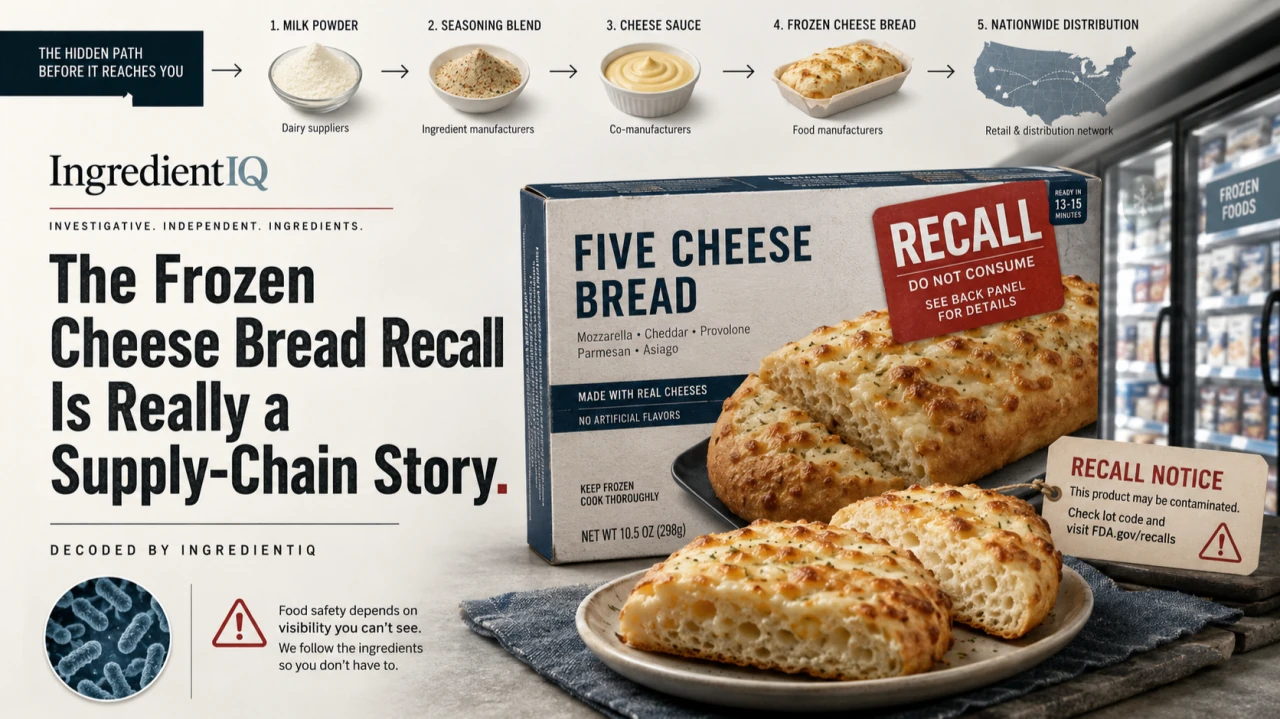
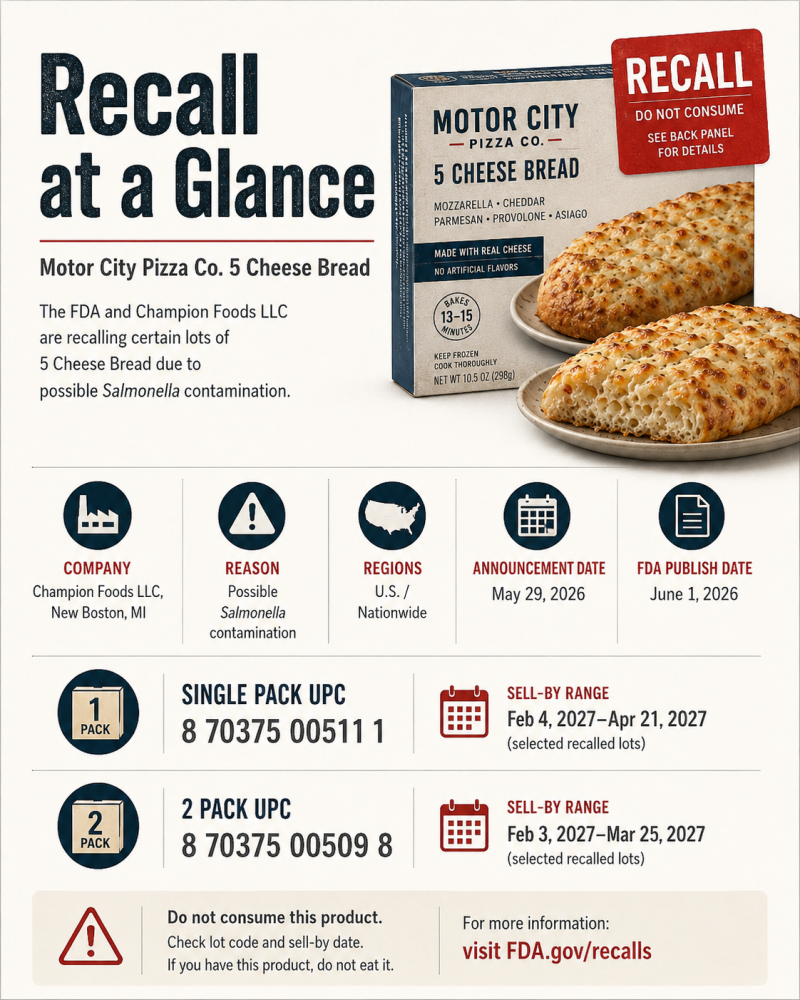
A box of frozen cheese bread looks like a simple product: dough, sauce, cheese, heat, eat. The Motor City Pizza 5 Cheese Bread recall shows how misleading that simplicity can be. On June 1, 2026, Champion Foods announced a voluntary recall of certain single-pack and two-pack 5 Cheese Bread products because a milk powder ingredient, sourced from a third-party seasoning manufacturer for a five-cheese sauce blend, may have been contaminated with Salmonella. No illnesses had been reported, and the seasoning batches tested negative before use. Still, the affected products had already moved through a national retail network that included Costco Wholesale , Walmart , Kroger , Target , Publix Super Markets , Meijer , Hy-Vee, Inc. -linked distribution and others.
The recalled product details are precise, but the consumer experience is not. A shopper has to find the sell-by date printed in black inside the cheese bread image on the front of the package, then compare it with a long list of dates ranging from February 2027 to April 2027. Single packs carry UPC 8 70375 00511 1. Two-packs carry UPC 8 70375 00509 8. The recall is national. The contaminant concern began upstream. The risk landed in freezers.
That is the quiet tension in modern food safety: the ingredient that matters most may be the one consumers never knew existed.
The Ingredient Trail
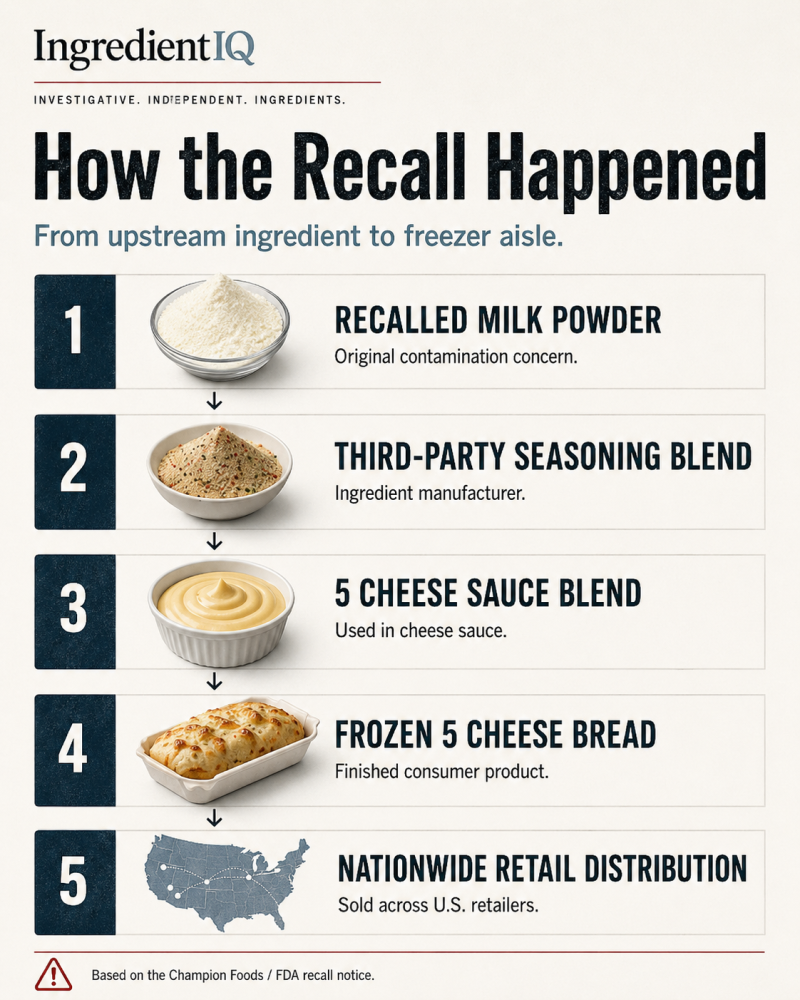
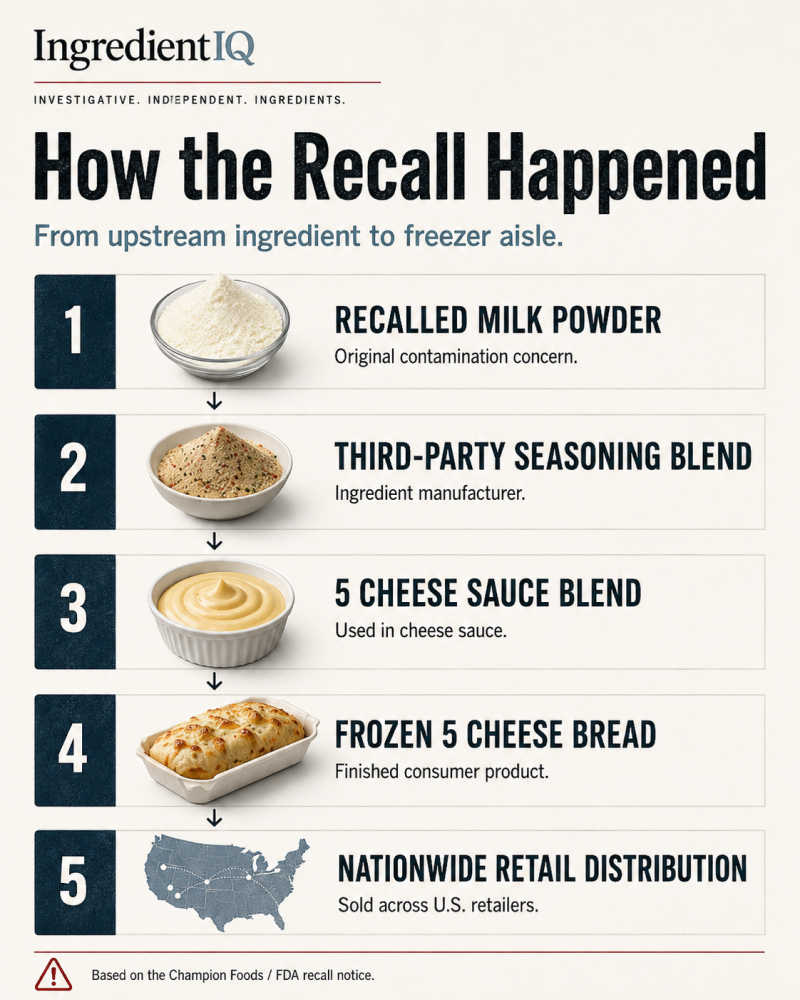
Champion Foods said the action followed a California Dairies Inc. milk powder recall tied to possible Salmonella contamination. The recalled milk powder was sent to a third-party manufacturer that produced a seasoning blend used in the 5 Cheese Bread’s cheese sauce. In other words, the recall did not begin with a visible ingredient like shredded cheese or crust. It began with a functional component inside another component, inside a branded frozen product.
FDA’s own “Major Product Recalls” page now lists 2026 recalls of food products associated with powdered milk from California Dairies Inc. due to a potential Salmonella risk as a newly added recall cluster. FDA says major recall pages are used when recalls have significant downstream effects, typically involving five or more related events.
That matters. A single ingredient supplier can become a multiplier. Powdered dairy can travel into seasonings, snack mixes, sauces, prepared foods, and frozen meals. By the time an alert reaches consumers, the ingredient has often been transformed beyond recognition.
What Salmonella Risk Means, Without Panic
Salmonella is not exotic. It is one of the leading bacterial causes of foodborne illness in the United States, and Centers for Disease Control and Prevention emphasizes that surveillance systems capture only a fraction of actual illness. That undercount matters because many people recover without testing, while severe cases are more likely to enter official data.
For most healthy adults, salmonellosis can mean fever, diarrhea, nausea, vomiting, and abdominal pain. For young children, older adults, and immunocompromised people, the stakes are higher. FDA’s recall notice warns that infection can become serious or fatal in vulnerable groups and, in rare cases, can spread into the bloodstream, causing arterial infections, endocarditis, or arthritis.
The confusing part is that “no reported illnesses” does not mean “no risk.” It means no illnesses had been reported to Champion Foods or its suppliers at the time of the announcement. It also means the recall is operating in the preventive zone, where the system is trying to remove possible exposure before illness data catches up.
The Broader Pattern: Recalls Are Becoming Ingredient Investigations
The Motor City case sits inside a larger regulatory moment. FDA says food producers recall products when they are mislabeled or when food may present a health hazard because it is contaminated or has caused a foodborne illness outbreak. In December 2025, FDA also reminded industry of its legal responsibilities for recalls and called for wider adoption of best practices in recall implementation, especially for foods consumed by infants and young children.
At the same time, FDA’s Food Traceability Rule, designed to support faster identification and removal of potentially contaminated foods, has been delayed. FDA states that the original compliance date was January 20, 2026, but the agency proposed extending it by 30 months to July 20, 2028, and later said Congress directed FDA not to enforce the rule before that date. The rule’s purpose is blunt: faster identification and rapid removal of contaminated food from the market, reducing illnesses and deaths.
That delay does not mean companies lack traceability obligations. It does mean the country is still living through a gap between what modern supply chains require and what many consumers can practically verify.
Recent investigative reporting has pointed in the same direction. ProPublica reported in late 2025 that foreign food inspections had dropped to historic lows outside the pandemic period, citing federal data and interviews with current and former FDA officials. Its report also noted that the FDA had delayed the traceability rule and that oversight capacity was under pressure at the same time imported and multi-ingredient foods were deeply embedded in the U.S. market.
Consumer Reports’ 2025 investigation into infant formula contaminants raised a related but distinct problem: ingredient safety is not limited to pathogens. CR tested 41 powdered formulas for arsenic, lead, BPA, acrylamide, and other contaminants, found that roughly half contained potentially harmful levels of at least one contaminant by its risk framework, then reported that the FDA announced a new infant-formula oversight initiative shortly after receiving CR’s findings. FDA’s Operation Stork Speed page confirms that the agency launched the initiative in March 2025 and, by April 2026, had issued increased testing results for infant formula contaminants.
Different hazards. Same lesson: consumers are being asked to trust ingredient systems they cannot see.
Why a Negative Test Didn’t End the Recall
Champion Foods said routine testing by the seasoning blend manufacturer showed that the tested seasoning batches were negative for Salmonella. That detail is important, and it should not be dismissed. Negative testing reduces concern. It does not erase it.
Microbial contamination is often uneven. A pathogen may not be present in the portion sampled. A contaminated upstream lot can be diluted, blended or distributed across multiple downstream products. Testing is a snapshot. Traceability is the map.
This is where food safety becomes less about one company and more about system design. The strongest question is not “Did the finished product test positive?” It is “Can every manufacturer, distributor, retailer, clinician and consumer quickly understand where the risky ingredient went?”
In this recall, the answer is partly yes. FDA posted the company notice. UPCs and sell-by dates are available. Retailers can remove affected products. Consumers can check packages. But the burden still falls heavily on the shopper standing in front of a freezer or rummaging through one at home.
The IngredientIQ Lens
IngredientIQ’s relevance here is not that it can replace FDA, CDC, manufacturers or retailers. It cannot. Public food safety depends on regulators with inspection authority, companies with enforceable obligations, and laboratories with validated methods.
IngredientIQ addresses the consumer-facing blind spot those systems leave behind: the inability to quickly understand a product by its ingredients, hidden sub-ingredients, risk flags, dietary relevance, and recall context.
A conventional label tells a shopper what the brand is required to disclose. A recall notice tells the public what has already gone wrong or might have gone wrong. IngredientIQ sits in the uneasy space between those two moments, where a consumer wants to know:
Is this ingredient relevant to my family’s risk profile?
Is this additive, allergen, contaminant concern or supplier-linked recall buried inside a larger formulation?
Does this product fit my dietary needs, medical restrictions or personal tolerance level?
What changed since I bought it?
That approach does not sensationalize food risk. It treats ingredient transparency as infrastructure. A parent checking a frozen snack, a dietitian advising a patient with immune compromise, or a journalist following a supplier-linked recall cluster all need the same thing: a clearer ingredient trail.
What Consumers Should Do Now
Consumers who have Motor City Pizza Co. 5 Cheese Bread should check the UPC and sell-by date against the recall notice. The affected single-pack UPC is 8 70375 00511 1, with sell-by dates ranging from 2/4/2027 through 4/21/2027. The affected two-pack UPC is 8 70375 00509 8 with listed sell-by dates from 2/3/2027 through 3/25/2027. FDA says the sell-by date is printed in black inside the cheese bread image on the front of the package.
Do not rely on memory of where it was purchased. The recall is nationwide, and the list of retailers is broad. Consumers can contact Champion Foods at info@motorcitypizzacompany.com.
Health professionals should treat recall exposure questions as ingredient questions, not just brand questions. Patients may not know they consumed a product containing recalled milk powder because that powder may have appeared inside a seasoning blend or sauce system.
Journalists should follow the supplier, not only the brand. FDA’s major recall cluster for California Dairies powdered milk is more important than any single product announcement.
Consumers can follow IngredientIQ’s social platforms for early-access ingredient alerts, recall explainers, and ongoing coverage of how hidden formulation choices affect everyday food decisions.
Health professionals can use IngredientIQ to support clearer patient conversations around food labels, exposure questions, and ingredient-level risk.
Journalists can use IngredientIQ as a starting point for tracing public-facing ingredient claims against regulatory documents, supplier-linked recalls, and emerging safety signals.
#FoodRecall #MotorCityPizza #Salmonella #FoodSafety #IngredientTransparency #IngredientIQ #FDARecall #FrozenFoodRecall #SupplyChainSafety #FoodTraceability #PublicHealth #ConsumerSafety