
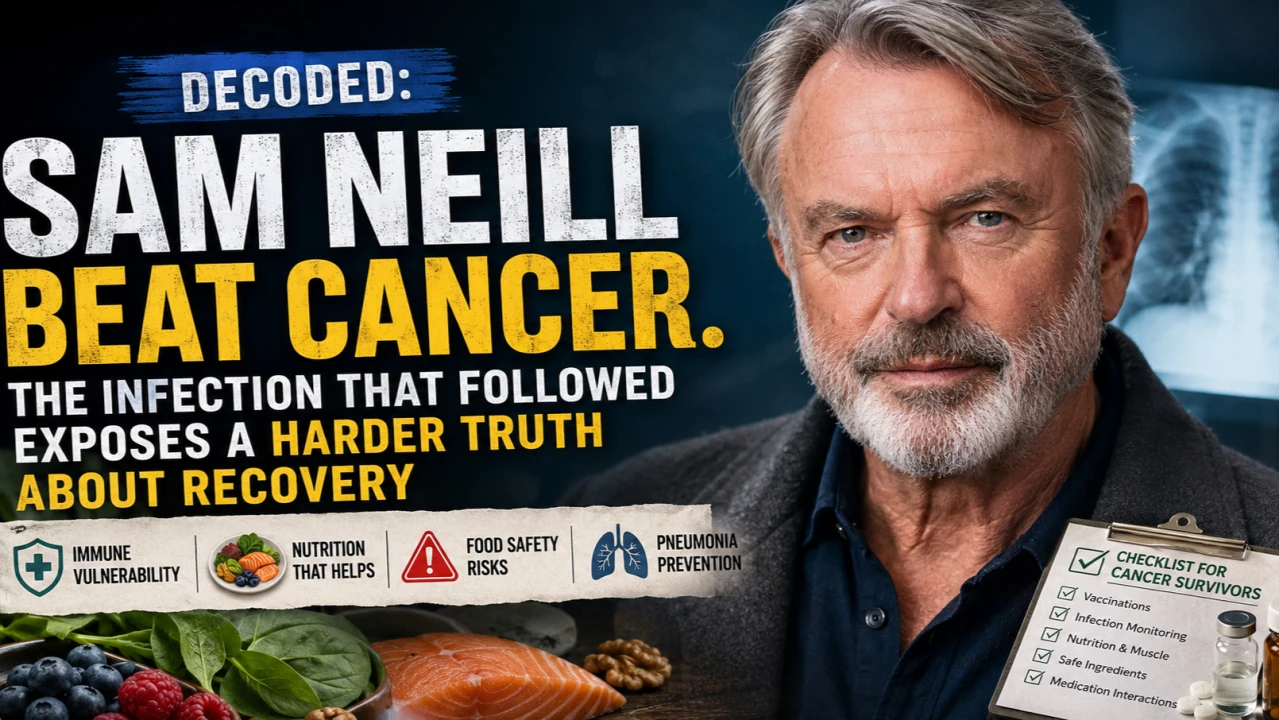
Three months after Sam Neill publicly celebrated being cancer-free, the 78-year-old actor died in Sydney. People close to him have attributed his death to pneumonia, describing an immune system strained by years of chemotherapy, immunotherapy and treatment for an aggressive blood cancer. Public reporting has not identified the organism responsible for the pneumonia, and no publicly available death certificate has confirmed the precise sequence of events. Still, the circumstances point to an overlooked reality of modern cancer care: eliminating detectable cancer does not necessarily restore the body that survived it.
Neill's death should not be turned into a parable about miracle foods. No berry, spice, supplement or "immune-boosting" powder prevents pneumonia or cures lymphoma. Nutrition cannot substitute for vaccination, infection monitoring, antimicrobial treatment or specialist oncology care.
But food is not irrelevant either.
For older cancer survivors, the consequential questions are more practical. Has treatment left the patient undernourished? Are they losing muscle? Are they getting enough protein and energy to recover? Could a supposedly healthy raw ingredient expose them to a foodborne pathogen? And does anyone examining the ingredient label know enough about the person eating it to distinguish nourishment from avoidable risk?
The celebration that concealed another vulnerability
Neill revealed in 2023 that he had been diagnosed with stage-three angioimmunoblastic T-cell lymphoma, a rare form of non-Hodgkin lymphoma. After conventional chemotherapy stopped controlling the disease, he later reported receiving CAR T-cell therapy and said in April 2026 that he was cancer-free.
CAR T-cell treatment is among the most striking advances in blood-cancer medicine. A patient's T cells are collected, genetically modified to recognize a target on cancer cells, multiplied and returned to the body. For some people whose disease has resisted other treatment, it can produce deep, lasting remission.
The same intervention can also reshape immunity.
Recent clinical reviews describe persistent low blood cell counts, reduced antibody production, and prolonged susceptibility to bacterial, viral, and fungal infections in some CAR T-cell recipients. A 2024 Nature Medicine analysis found that infections accounted for the largest share of deaths unrelated to cancer relapse after CAR T-cell therapy. Subsequent reviews have emphasized that infectious complications can remain significant well beyond the dramatic early treatment period.
That does not prove CAR T-cell therapy caused Neill's pneumonia. His full medical record is not public. Pneumonia can be bacterial, viral, fungal or aspiration-related, and the word alone tells us little about its origin.
The responsible conclusion is narrower: remission and immune recovery are different clinical outcomes.
Cancer may no longer be detectable while antibody levels remain low. A scan can look reassuring while muscle and nutritional reserves continue to fall. A person can return to work, travel and ordinary life while remaining less able to contain an infection that a healthier immune system might withstand.
In oncology, survival is sometimes announced when the tumor disappears. Biology keeps counting.
What food can do, and where the promise ends
Search engines are crowded with claims that garlic "kills cancer," turmeric replaces chemotherapy, mushrooms activate immunity and vitamin megadoses prevent respiratory infections. The language is seductive because it offers agency at the exact moment patients feel least in control.
The evidence supports a less cinematic role for food.
A varied diet can provide protein for tissue maintenance, carbohydrates and fats for energy, and vitamins and minerals required for ordinary immune function. It can help preserve body weight and lean mass. Over the years, dietary patterns rich in vegetables, fruit, whole grains, legumes, and other minimally processed foods have been associated with a lower risk of several chronic diseases, including some cancers. The World Health Organization's 2026 healthy-diet guidance places those foods within a broader pattern that limits excess salt, free sugars and unhealthy fats.
Yet reviews of nutrition guidance for cancer survivors find that evidence for individual foods and their effects on survival outcomes remains uneven. Much of the stronger research concerns overall dietary patterns, with substantial gaps for older adults and survivors of less common cancers.
The distinction matters. Food can support health. It cannot guarantee protection against cancer recurrence or pneumonia.
For someone recovering from intensive cancer treatment, the most useful ingredients are often ordinary rather than exotic:
Protein-rich foods
, including eggs cooked until firm, fish, poultry, beans, lentils, tofu, yogurt and pasteurized dairy products, can help maintain muscle and provide amino acids needed for repair. Some patients need more protein and calories than standard healthy-eating advice would suggest, particularly after weight loss or during treatment.
Whole grains, legumes, vegetables, fruit, nuts and seeds
provide fiber and a range of micronutrients. These foods align with the dietary patterns most consistently recommended for long-term health, although tolerance may change during treatment due to nausea, mouth sores, diarrhea, or digestive surgery.
Oily fish
, such as salmon, sardines and trout, supply protein and omega-3 fats. It is food, not an anticancer drug. Concentrated fish-oil supplements can interact with medicines or affect bleeding risk and should not be treated as interchangeable with a serving of fish.
Vitamin D sources
, including fortified milk, fortified plant beverages, eggs and oily fish, may help people meet normal nutritional requirements. Vitamin D is involved in immune regulation, but that biological role does not establish that high-dose supplementation prevents pneumonia or cancer recurrence.
Zinc-containing foods
, such as seafood, meat, beans, dairy products, nuts and seeds, support normal immune processes. More is not necessarily better. Excess supplemental zinc can cause toxicity and interfere with copper absorption.
Colorful produce
, including berries, citrus, leafy greens, tomatoes, carrots, and cruciferous vegetables, provides vitamins, minerals, and phytochemicals. Their value lies in the dietary pattern they help form, not in a claim that a single antioxidant can neutralize cancer.
This is the sober version of "food as medicine." Nutrition can help preserve the body's capacity to recover. Medicine still treats the disease.
When a healthy ingredient becomes a microbial risk
The advice becomes more complicated when immunity is suppressed.
A raw sprout may look wholesome, yet its warm, humid growing conditions can support bacteria. Unpasteurized milk, soft cheeses made from unpasteurized milk, raw shellfish, undercooked eggs, rare meat, and refrigerated smoked seafood may carry organisms that pose much greater danger to someone with impaired immunity than to the average shopper.
The US FDA warns that older adults and people with cancer or weakened immune systems are especially vulnerable to foodborne illness. It advises higher-risk individuals to avoid raw or lightly cooked sprouts and to take particular care with raw animal products, unpasteurized foods, and cross-contamination.
This creates a tension rarely captured by wellness culture. The ingredient with the strongest “natural” image may not be the safest ingredient for the person eating it.
Even labels can obscure the decision. “Cultured,” “farm fresh,” “cold pressed,” “raw,” “probiotic,” and “minimally processed” sound beneficial, but none automatically answers the questions an immunocompromised consumer needs resolved:
Was it pasteurized? Does it contain a live organism? How much added sugar or sodium is present? Could the product interact with medication? Is the serving size realistic? Does the person need fiber, or are they currently being told to restrict it? Is weight loss a greater immediate threat than the product’s saturated-fat content?
Nutrition after cancer is not a universal ranking of foods as good or bad. It is a shifting risk assessment.
Pneumonia prevention is larger than the plate
A diet that helps an older adult maintain weight and muscle mass may improve resilience, but preventing pneumonia depends heavily on measures outside the kitchen.
In the United States, the Centers for Disease Control and Prevention recommends pneumococcal vaccination for adults aged 50 and older, as well as younger adults with certain risk conditions. Immunocompromised patients may require individualized timing because cancer treatment can weaken vaccine responses or require revaccination. Influenza, COVID-19, and other respiratory vaccination decisions also belong in that clinical conversation.
CAR T-cell infection guidance discusses antimicrobial prophylaxis, immunoglobulin replacement for selected patients, monitoring of blood counts and antibody levels, and carefully planned revaccination. Those interventions have a different evidentiary status from claims printed on supplement bottles.
The contrast is uncomfortable. Consumers are routinely encouraged to monitor calories, protein and vitamin percentages, yet the factors that may matter most after cellular therapy, including treatment history, immune-cell recovery, immunoglobulin levels, vaccine status and infection exposure, are rarely connected to food guidance.
A generic "heart healthy" score cannot answer whether an older lymphoma survivor should avoid raw sprouts. A wellness app that praises weight loss may miss treatment-related malnutrition. An ingredient scanner that identifies vitamin C but ignores grapefruit-drug interactions offers information without context.
That gap is where transparency has to become personal.
The missing layer in ingredient intelligence
Most food-label tools interpret the product. They do not adequately interpret the relationship between the product and the person.
IngredientIQ 's more defensible role is not to declare that a food fights cancer or prevents pneumonia. It is to help expose the questions hidden by a crowded label: pasteurization status, raw-food risks, nutrient density, sodium, added sugars, allergens, supplement-level doses, medication-interaction flags and the difference between population-level nutrition advice and individual clinical needs.
For an older consumer in ordinary health, a product might receive one interpretation. For someone recovering from chemotherapy, living with low white-cell counts or preparing for cellular therapy, the same ingredient list may require a different warning.
That is not a claim of diagnosis. It is a case for structured caution.
Personalization should also have boundaries. An algorithm cannot know a person's current immune status unless reliable information is provided. It should not infer that remission means normal immunity. It should not label an ingredient “anticancer” on the basis of a laboratory experiment, or convert an association into a promise.
A credible system would show the evidence behind each conclusion, identify uncertainty, separate food from supplements, and direct high-risk users to their oncologist or oncology dietitian when the decision exceeds what a label can safely answer.
The prevailing consumer-food model asks, “Is this ingredient healthy?”
The better question is, “Healthy for whom, in what condition, at what dose, and at what point in treatment?”
What Sam Neill's final months should change
Neill's reported cancer-free milestone was real and worth celebrating. So was the medical achievement behind it. His death does not negate CAR T-cell therapy or suggest that advanced treatment is futile.
It shows why recovery cannot be reduced to a binary word.
A person can be cancer-free and medically fragile. Someone may look well while carrying an altered immune system. A food promoted for “immunity” can be nutritionally useful, useless, interactive, or unsafe depending on how it was produced and who is consuming it.
For families, the lesson is not to search for a stronger superfood. It is to ask better questions of the treatment team:
What infections is this person currently most vulnerable to? Has immune recovery been measured? Are vaccinations current and appropriately timed? Is weight or muscle being lost? Are any raw foods, supplements or live-culture products temporarily unsafe? Could a medication interact with grapefruit, green tea extracts, high-dose antioxidants or herbal ingredients?
For health professionals, nutrition and food-safety screening should not begin only after obvious weight loss. Ingredient advice belongs inside survivorship planning, particularly for older adults and people who have received treatments capable of causing prolonged immune dysfunction.
For journalists, “cancer-free” should not be reported as a synonym for fully recovered. Stories about breakthrough therapies need room for infection risk, nutritional decline, follow-up care and the long medical shadow cast by successful treatment.
IngredientIQ will continue examining that shadow: not to turn food into medicine, but to make ingredient information more accountable to the human being reading it.
Follow IngredientIQ's social platforms for early access to new Decoded investigations, evidence updates, and ingredient risk analyses.
#CancerSurvivorship #CARCellTherapy #PneumoniaAwareness #CancerNutrition #HealthyAging #FoodSafety #Immunocompromised #IngredientTransparency #Cancer #OncologyNutrition #PublicHealth #PersonalizedNutrition #SamNeill #IngredientIQ