
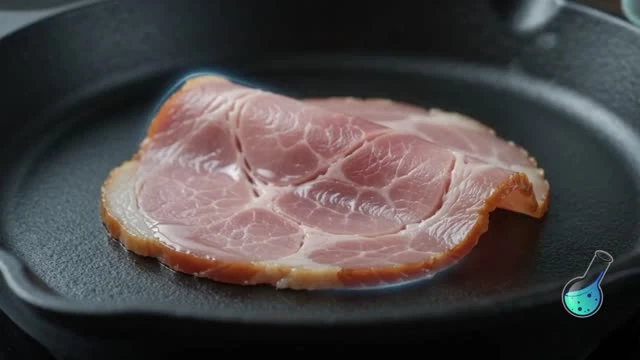
The Pink Meat Paradox: The Preservative That Stops Deadly Bacteria and Feeds Cancer Chemistry
An IngredientIQ investigation into sodium nitrate, sodium nitrite, nitrosamines, and the gap between a legal food label and an informed decision.
In August 2025, laboratory testing commissioned by a British advocacy coalition examined 21 supermarket ham and bacon products. Every sample contained nitrite. Tesco 's Wiltshire ham had nearly 33 milligrams per kilogram, roughly 11 times the amount measured in the retailer's cooked ham. Yet all 21 products were comfortably below the legal ceiling then cited by the investigators.
That contrast matters. A product can comply with the law and still raise a legitimate question about avoidable exposure. It can carry a reassuring label while relying on essentially the same curing chemistry as the product beside it. It can protect against acute food poisoning today while contributing, under certain conditions, to chemical reactions associated with cancer risk over decades.
Sodium nitrite is neither a cartoon villain nor an inert technicality. It is a highly functional preservative caught inside a public-health tradeoff.
The investigation begins with a deceptively simple question: when consumers see a pink slice of ham, what exactly are they looking at?
The Chemistry Behind the Color
Freshly cooked pork naturally tends toward gray or brown. The stable pink color associated with bacon, hot dogs, ham, and deli meat usually signals curing chemistry, not freshness.
Sodium nitrite supplies nitrite ions. Those ions react with myoglobin and heme compounds in meat, creating the characteristic cured color and flavor. Nitrite also slows oxidation and helps control microorganisms, including Clostridium botulinum, the bacterium responsible for botulism. Sodium nitrate is more stable and can act as a reservoir that microorganisms gradually convert into nitrite, particularly in long-cured products.
These functions are real. Removing nitrite without redesigning the product's manufacturing process, refrigeration requirements, packaging, shelf life, and microbial controls could introduce a different hazard.
But nitrite is chemically reactive. In meat, during high-temperature cooking, or in the acidic conditions of digestion, it can participate in reactions involving amines and heme compounds. Some of the resulting N-nitroso compounds, including certain nitrosamines, are genotoxic and carcinogenic. Nitrosyl-heme, the same chemistry involved in the familiar pink color, is also being investigated as a possible contributor to the colorectal effects associated with processed meat.
Formation is not automatic. The amount depends on the recipe, residual nitrite, meat composition, antioxidants, acidity, storage, temperature, and cooking method.
That qualification shouldn't be mistaken for reassurance. It is the reason simplistic ingredient labels fail.
The Cancer Evidence Is Stronger for the Food Category Than for One Ingredient
Processed meat is an established colorectal cancer risk factor. In February 2026, the World Health Organization listed diets high in processed and red meat among the factors that increase colorectal cancer risk. WHO estimates that colorectal cancer accounted for about 1.9 million diagnoses and more than 900,000 deaths worldwide in 2022, with a rising burden among adults aged 30 to 50 in some settings.
What scientists cannot do cleanly is assign the entire processed-meat effect to sodium nitrite.
A strip of bacon is a chemical system. It may contain nitrite, heme iron, salt, fat and compounds created by smoking or high-temperature cooking. Consumption patterns are also entangled with other dietary and lifestyle factors. Researchers must separate one exposure from another using studies that often depend on people remembering what they ate years earlier.
Still, regulators have not dismissed the nitrosamine pathway.
In 2023, the European Food Safety Authority (EFSA) concluded that dietary exposure to N-nitrosamines raised a health concern. Meat and meat products were identified as the most important food group contributing to exposure. EFSA's assessment considered actual nitrosamines occurring in food, rather than treating the presence of nitrate or nitrite alone as proof of harm.
This distinction is crucial:
Nitrite is a precursor and curing agent. A nitrosamine is a reaction product. Processed meat is the full exposure.
Confusing those three levels produces two equally unreliable conclusions. One says every trace of nitrite is dangerous. The other says a product is safe simply because its added nitrite complies with a legal maximum.
Neither position describes the evidence well.
What a U.S. Survey Found in More Than 1,100 Products
A 2025 study published in Scientific Reports measured residual nitrite and nitrate in 1,132 processed meat products produced across three U.S. regions. It also analyzed 53 plant-based meat analogs.
Processed meats averaged 13.7 parts per million of residual nitrite and 32.6 parts per million of residual nitrate. The ranges were wide. Nitrite values extended from zero to 214.5 parts per million, while nitrate ranged from 2 to 205.9 parts per million. Plant-based analogs had lower average levels in this dataset.
Residual concentration is not the same as the amount originally added. Nitrite and nitrate can degrade, convert into one another, or react with other food components during manufacturing and storage.
Nor does the highest measurement identify the most dangerous product. Cancer risk cannot be calculated from one residual value without knowing consumption, nitrosamine formation, the wider formulation and the individual eating it.
The study's more useful finding is variability. "Processed meat" is not one chemically uniform exposure. Two products that look interchangeable in a refrigerator case may contain very different residual levels.
A label that lists an ingredient but offers no quantity leaves the consumer unable to see that difference.
The "Uncured" Loophole Is a Chemistry Lesson
"Uncured" is one of the most misunderstood words in the meat aisle.
Conventionally cured meat may list sodium nitrite directly. Products marketed as uncured may instead use celery powder, celery juice, beet-derived ingredients, or other concentrated vegetable sources of nitrate. Bacterial cultures convert that nitrate into nitrite during processing.
The source has changed. The curing reaction has not disappeared.
Consumer Reports has repeatedly warned that an "uncured" claim can describe the source of the curing agent rather than the absence of nitrate or nitrite chemistry. Its 2023 review of misleading food labels noted that celery-derived curing systems may be used in products carrying "uncured" language.
This doesn't mean celery and sodium nitrite are nutritionally identical in every context. Whole vegetables contain fiber, vitamins, and phytochemicals and are not eaten inside the same heme-rich, salted meat matrix. It does mean that concentrated celery powder used to cure a hot dog should not inherit the health halo of a celery stalk.
Consumers searching for "nitrate-free deli meat" are often trying to answer a health question. The label may be answering a regulatory sourcing question instead.
Three Investigations, One Repeating Pattern
Recent reporting has exposed the same problem from different angles.
In 2023, Consumer Reports examined children's lunch and snack kits. Sodium nitrite appeared in the processed meat used in some products, alongside concerns about sodium, lead, cadmium, and phthalates. None of the kits exceeded the legal limits evaluated by the organization. The concern was repeated exposure from products designed for frequent use, not a single lunch causing acute illness.
The 2025 Guardian laboratory investigation found nitrite in all 21 ham and bacon samples tested. The highest measured product still complied with the cited legal limit, neatly illustrating why "legal" and "exposure-minimized" are different standards.
By early 2026, Guardian reporting based on Worldpanel by Numerator data found that the value of nitrite-cured bacon sales in the United Kingdom had fallen 7.3% over a 12-week year-over-year period, while nitrite-free alternatives rose 21.7%. The data came through an anti-nitrite coalition and should be interpreted with that provenance in mind, but the direction suggests that shoppers are beginning to act before scientific and regulatory debates are settled.
The public is not waiting for a chemistry seminar. It is making decisions from front-of-package language that may not reveal the chemistry clearly.
Europe Lowered Its Limits. The United States Removed an Obsolete Test.
In October 2023, the European Commission adopted lower limits for nitrite and nitrate food additives. The Commission explicitly described the rule as an attempt to preserve protection against pathogens such as Listeria, Salmonella and Clostridia while reducing exposure to potentially carcinogenic nitrosamines. Food businesses were given two years to adapt to the new limits.
The policy did not declare nitrite unnecessary. It concluded that less could be used while maintaining microbial safety.
The United States took a different regulatory action in July 2025. USDA ’s Food Safety and Inspection Service removed regulations for an obsolete program that sampled pumped bacon for nitrosamines. The agency had stopped collecting those samples in October 1998, after finding few confirmed positives and concluding that the prescribed cooking and testing method no longer reflected consumer behavior.
This was an administrative cleanup, not the repeal of curing controls. FSIS continues to prohibit nitrate in pumped bacon, limits ingoing nitrite to 120 parts per million, and requires sodium ascorbate or sodium erythorbate to reduce residual nitrite and nitrosamine formation. Inspectors verify formulations and processing requirements.
Still, the chronology is striking. A federal nitrosamine sampling program stopped in 1998, remained written into regulation for more than a quarter-century, and was formally removed in 2025.
USDA-FSIS says formulation and process controls make the old testing program unnecessary. A reasonable public-interest question remains: how much current, publicly accessible surveillance measures the nitrosamines consumers encounter in finished processed meats under modern cooking conditions?
The rule answers how establishments are checked for compliance. It does not give shoppers a product-by-product exposure map.
Why "Ban It" Isn't a Complete Safety Strategy
A 2023 study in npj Science of Food tested cooked-ham formulations containing 120, 90 or zero milligrams of added sodium nitrite per kilogram. Researchers examined microbial growth, chemical markers, the intestinal environment and preneoplastic lesions in a rat model.
Reducing nitrite from 120 to 90 milligrams per kilogram lowered several markers associated with nitrosation and colon carcinogenesis. Both 90 and 120 milligrams slowed Listeria monocytogenes growth during the first three weeks of storage compared with the nitrite-free formulation. Completely removing nitrite increased lipid oxidation, and it did not provide clearly greater protection against the measured carcinogenesis markers than the reduced-nitrite formulation.
This was an animal and food-model experiment. It cannot tell a person how many slices of ham will cause cancer. It can tell regulators and manufacturers something valuable: a lower level may preserve much of nitrite's microbial function while reducing undesirable chemistry, and zero is not automatically the safest formulation unless other controls are redesigned.
The study also tested replacement systems. Some vegetable-derived alternatives still produced nitrite through fermentation. Others controlled oxidation or microbes less effectively. A "natural" substitute may therefore recreate the original chemistry, introduce a different problem, or both.
The scientifically serious goal is not ingredient subtraction. It is safer product design.
What Consumers Can Actually Do
The largest practical lever is frequency.
An occasional serving is not equivalent to daily exposure. Consumers who regularly eat bacon, hot dogs, cured sausage, pepperoni, ham, or deli meat can reduce processed-meat frequency without waiting for every mechanistic question to be resolved. The 2026 European Code Against Cancer Kyrgyzstan advises avoiding processed meat as part of a cancer-prevention diet, while the World Cancer Research Fund says no intake level has been identified as having no colorectal cancer risk.
Read past the front label. In the ingredient list, look for sodium nitrite, sodium nitrate, potassium nitrite and potassium nitrate. Also notice celery powder, cultured celery juice and similar concentrated curing ingredients. The qualifier "except those naturally occurring in…" often tells more than the large "no nitrites added" claim.
Avoid treating "organic," "natural" and "uncured" as toxicology findings. Those terms may describe farming methods, ingredient origin or regulatory categories. They don't measure the finished product's nitrosamines.
Cooking matters too. USDA ’s consumer guidance summarizes research in which some nitrosamines were found in bacon subjected to higher-temperature or burned conditions, while lower-temperature conditions did not produce detectable results in that experiment. Avoiding blackened or heavily charred bacon is a sensible exposure-reduction step, though it does not make frequent processed-meat consumption risk-free.
Parents face a particularly difficult version of the problem. A lunch kit may be legally compliant and convenient, yet still combine processed meat, high sodium, and several other exposures in a product designed for repetition. The useful question is rarely "Is one lunch toxic?" It is "What pattern does this product create across a school year?"
The Information Failure IngredientIQ Is Designed to Address
The present labeling system tends to separate facts that consumers need to see together.
A package may disclose sodium nitrite without explaining its function. Another may advertise "uncured" while using a nitrate-rich vegetable concentrate. Neither label describes likely frequency, relevant health goals, product alternatives, or the difference between a precursor and a carcinogenic reaction product.
IngredientIQ's role is not to brand sodium nitrite as poison. That would ignore its antimicrobial purpose and the consequences of careless removal.
The more credible approach is to decode five layers at once:
Identity.
Is the curing agent sodium nitrite, sodium nitrate, or a vegetable-derived source?
Function.
Is it being used for microbial safety, color, flavor, shelf life, or several purposes?
Reaction potential.
Does the food matrix contain heme and amines? Is the product commonly fried, grilled, or charred?
Exposure pattern.
Is this an occasional holiday food, a daily sandwich filling, or a recurring component of a child's lunch?
Personal relevance.
Does the user need to reduce processed meat, sodium, or overall colorectal cancer risk? Are there family-history or clinical factors that belong in a conversation with a health professional?
This is where AI-driven personalization can serve ingredient transparency rather than replace medical judgment. It can recognize that "cultured celery powder" may be part of a curing system, compare products within the same category, show the strength and limits of the evidence, and explain why a lower-frequency alternative may matter more than a reassuring adjective on the package.
A red warning icon cannot do that. Neither can a green one.
The Accountability Test
Manufacturers know the ingoing concentration of curing agents. They know the antioxidants used, processing temperatures, storage conditions, and intended shelf life. Regulators know the permitted limits and required controls. Researchers know that residual concentrations vary substantially across products.
Consumers see "uncured."
That imbalance is not inevitable. Finished-product testing can be modernized. Quantitative disclosures can become more accessible. Label rules can distinguish the absence of conventional sodium nitrite from the use of vegetable-derived nitrate curing systems. Public databases can connect ingredients, product categories, and regulatory evidence without forcing shoppers to search technical dockets.
The unresolved question is no longer whether nitrite has benefits or whether processed meat carries risk. Both are supported.
The question is why consumers are still expected to navigate the tradeoff with language that obscures the chemistry.
What Happens Next
For consumers:
Treat processed meat as an occasional food rather than a routine protein source. Read the full ingredient list, compare similar products, and use IngredientIQ to investigate curing sources and realistic alternatives. Follow IngredientIQ's social platforms for early access, product analyses, and continuing coverage.
For health professionals:
Separate the established processed-meat evidence from claims about one isolated additive. Help patients focus on dietary patterns, frequency and clinically relevant risk. IngredientIQ's evidence trail can support clearer conversations without presenting an app-generated assessment as diagnosis.
For journalists:
Ask companies for incoming nitrite levels, finished-product residual data, nitrosamine testing methods and the basis for "uncured" claims. Ask regulators what current surveillance captures after processing, storage and real-world cooking. IngredientIQ welcomes labels, documents and product tips for future editions of Decoded.
The most honest conclusion is not that every slice of ham is dangerous.
It is that the chemistry is more consequential than the label lets on.
#IngredientTransparency #FoodAdditives #SodiumNitrite #SodiumNitrate #ProcessedMeat #Nitrosamines #FoodSafety #CancerPrevention #FoodLabeling #PublicHealth #ConsumerHealth #IngredientIQ