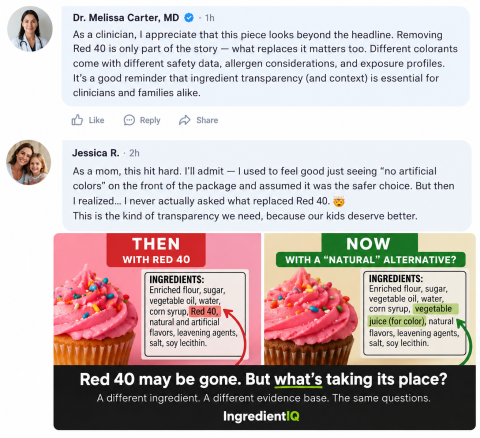

The synthetic dye at the center of a quiet reformulation wave, a widening labeling gap, and a question regulators still haven't fully answered: what should replace it?
Published by IngredientIQ | September 23, 2026
A student walking into a school cafeteria this fall may encounter a food supply that looks almost exactly like last year's, but is chemically different.
Aramark Student Nutrition , which operates in more than 350 school districts, says its updated 2026–27 menu program has removed artificial dyes from core offerings. Target committed to eliminating certified synthetic colors from every cereal it sells, in stores and online, by the end of May. Nestlé USA says it has removed FD&C colors from its U.S. food and beverage portfolio. Other major manufacturers are working toward similar deadlines. The FDA's own tracker now records dozens of reformulation commitments.
At the center of much of this activity is an ingredient that remains perfectly legal under federal law:
FD&C Red No. 40.
Also called Red 40, Allura Red AC, or E129, it is a certified synthetic color used to produce shades ranging from pink to deep red. FDA continues to list Red 40 as permanently authorized for use in foods, drugs, and cosmetics.
That creates an unusual moment in American food regulation.
Companies are racing to remove an ingredient the government still permits.
Schools are moving away from it.
Retailers are changing policies around it.
The United Kingdom requires products containing Allura Red to carry a warning that it "may have an adverse effect on activity and attention in children." The United States does not.
And beginning January 15, 2027, another red synthetic dye, Red No. 3, will lose its federal authorization in food entirely.
So what exactly is happening with Red 40?
And when one controversial color disappears, what prevents another from quietly taking its place?
The food aisle changed before the law did
The current shift did not begin with a Red 40 ban.
There isn't one at the federal level.
In April 2025, the U.S. Department of Health and Human Services (HHS) and FDA announced plans to work with manufacturers to phase out six widely used certified colors, including Red 40, Yellow 5, Yellow 6, Blue 1, Blue 2, and Green 3. The initial announcement described an end-of-2026 objective. STAT reported at the time that manufacturers had agreed voluntarily and emphasized an important regulatory detail: no formal federal ban required the six colors to disappear.
The timetable subsequently evolved.
FDA's current tracker says the agency is working with industry to eliminate the six colors by the end of 2027, and lists company-by-company commitments rather than a regulation prohibiting their use.
That distinction matters.
A prohibited ingredient and a voluntarily abandoned ingredient may look identical to a shopper once both vanish from a package. Legally, they are very different.
The change is also happening unevenly. One company may have completed its transition. Another may be halfway through. A third may retain the dye in some products while reformulating others.
Then there are schools.
The Consumer Brands Association committed participating manufacturers to removing certified FD&C colors from products served in schools beginning with the 2026–27 school year. California has gone further by restricting synthetic food dyes in school foods.
A curious result follows.
A color may be absent from a child's school breakfast but remain federally authorized in the snack that child buys later that afternoon.
That isn't a hypothetical regulatory puzzle. It's the market Americans are entering now.
Red 3 created a deadline. Red 40 created a question.
The story becomes more complicated because Red 40 is often discussed alongside Red 3, even though the regulatory and toxicological cases are different.
FDA revoked authorization for FD&C Red No. 3, or erythrosine, in food in January 2025. Food manufacturers have until January 15, 2027, to comply.
The legal mechanism was the Delaney Clause, a provision of federal law that bars approval of additives shown to induce cancer in humans or animals.
High-dose studies had produced thyroid tumors in male laboratory rats. FDA has also been explicit about an important limitation: the agency says the mechanism involved is specific to male rats, has not been demonstrated in humans, and that available evidence does not support claims that Red 3 exposure in food causes cancer in people.
That nuance is routinely lost once a headline becomes “FDA bans red dye.”
More importantly, the Red 3 decision does not establish that Red 40 has the same cancer evidence or should be treated as toxicologically interchangeable.
Red 40 remains authorized.
But removing Red 3 forces thousands of product-development decisions.
Every pink frosting, fruit-flavored candy, drink mix, dessert topping, children's snack, or medication that relied on Red 3 needs another way to achieve its color.
Some manufacturers will move toward beet-derived pigments, anthocyanins, carmine, paprika extracts, spirulina combinations, or other approved color systems. FDA has accelerated work on additional colors derived from non-petroleum sources.
Others may reconsider color altogether.
And that raises the question regulators rarely put on the front of a package:
When an ingredient leaves a formulation, what replaced it?
A reformulation can reduce one exposure while introducing another ingredient with an entirely different evidence base, stability profile, allergen consideration, manufacturing process, or labeling name.
“Removed” is only half the story.
Why Red 40 matters more than most dyes
Red 40 is not an obscure additive hiding in a tiny corner of the food system.
A 2025 peer-reviewed analysis in the Journal of the Academy of Nutrition and Dietetics examined ingredient data for 39,763 packaged foods and beverages from the 25 largest U.S. manufacturers.
Synthetic dyes appeared in 19 percent of products.
Red 40 was the most common, appearing in 14 percent of products. Among categories heavily marketed to children, synthetic dyes appeared significantly more often than in other categories.
The dataset came from 2020, so it does not describe the rapidly reformulating 2026 marketplace. That limitation is important.
But it demonstrates the scale of the starting point.
This isn't a niche ingredient being removed from a handful of candies. Red 40 became embedded across a large portion of the packaged-food environment.
Which leads to a harder scientific question.
If it was used so broadly, how certain are we about the levels people actually consume?
What the science says, and what it doesn't
Two mistakes routinely distort the food-dye debate.
The first is declaring Red 40 proven harmless because the FDA authorized it.
The second is declaring it proven dangerous because companies are removing it.
Neither follows from the evidence.
FDA's current consumer guidance says the totality of scientific evidence indicates most children do not experience adverse behavioral effects from foods containing approved color additives, while acknowledging evidence suggesting that certain children may be sensitive. The agency says additional neurobehavioral research is needed.
International authorities have also evaluated Red 40, known internationally as Allura Red AC.
The Joint FAO/World Health Organization Expert Committee on Food Additives has maintained an acceptable daily intake of 0 to 7 milligrams per kilogram of body weight per day. Its assessment concluded that estimated dietary exposure in children and other age groups did not present a health concern at the levels it evaluated.
That is one side of the regulatory record.
The unsettled area involves neurobehavior.
The scientific literature has produced signals suggesting that synthetic color exposure may worsen activity- or attention-related symptoms in some children. The evidence does not establish that every child reacts, that Red 40 independently causes ADHD, or that ordinary exposure inevitably produces a measurable behavioral effect.
Those are much stronger claims than the evidence supports.
But uncertainty isn't the same thing as absence of a signal.
The 2025 packaged-food study itself notes decades of questions around neurobehavioral effects, particularly for certain children, and the prevalence of these dyes in products marketed toward younger consumers makes the exposure question consequential even when individual susceptibility varies.
FDA's language reflects that tension remarkably well: most children appear unaffected, some may be sensitive, and more research is needed.
That's less satisfying than either "safe" or "dangerous.”
It is also more scientifically defensible.
Then Consumer Reports tested actual food
In June 2026, Consumer Reports and the food-scanning company Yuka published laboratory results for 40 popular U.S. food products containing various additives.
Among 13 products labeled as containing Red 40, the investigation detected the dye in 12. Five contained enough in a single serving to exceed a child-focused benchmark Consumer Reports derived from California's Office of Environmental Health Hazard Assessment work. Several products contained considerably more.
Those figures should be interpreted carefully.
The California-derived benchmark Consumer Reports used is not the same as FDA's federal acceptable daily intake. A product exceeding CR's benchmark does not mean FDA has determined that serving to be unsafe.
That distinction is essential.
The investigation nevertheless exposed a transparency problem that survives the disagreement over thresholds: a consumer can see Red 40 on an ingredient list, but the label normally does not disclose how much Red 40 is present.
Two products can contain the same listed ingredient at very different concentrations.
For a person trying to reduce exposure, the ingredient list answers a binary question.
Present or absent.
It usually cannot answer the next one.
How much?
America and Britain don't read the same label
There is another striking difference.
In Great Britain, foods containing Allura Red, the same compound Americans know as Red 40, must carry the statement:
“May have an adverse effect on activity and attention in children.”
The warning also applies to several other synthetic colors.
Red 40 is still permitted there under regulated conditions. The warning does not mean British authorities have declared that every child will experience behavioral effects.
It means regulators reached a different conclusion about what information belongs in front of the consumer.
That distinction is revealing.
Food regulation isn't only a question of whether a chemical can legally be used.
It is also a question of what uncertainty consumers deserve to see.
A parent buying a brightly colored product in Chicago and a parent buying a comparable product in London can encounter different risk communication around the same molecule.
The chemistry did not cross a border and change.
The disclosure standard did.
Now even “no artificial colors” means something different
In February 2026, FDA introduced another wrinkle.
The agency said it would exercise enforcement discretion allowing certain foods without certified FD&C colors to use claims such as “no artificial colors”, even when the product contains other approved color additives derived from different sources.
The change was intended to make it easier for manufacturers to move from certified synthetic colors toward alternatives.
But the phrase can sound broader than the policy.
“No artificial colors” does not necessarily mean no added color.
The Guardian reported criticism from food-policy researchers who argued that the new approach could confuse shoppers about what remains in a formulation. The underlying FDA letter confirms that the policy applies to foods without FD&C-certified colors and allows other approved colors under existing requirements.
This may become one of the most consequential parts of the transition.
Consumers are being asked to interpret an evolving vocabulary while manufacturers rewrite ingredient lists.
“Natural.”
“Artificial.”
“Certified.”
“Color added.”
“Derived from natural sources.”
“FD&C Red 40.”
“Allura Red AC.”
“E129.”
These terms do not necessarily describe the same regulatory category, and some are names for the exact same chemical ingredient.
A shopper should not need a chemistry reference and three regulatory databases to understand that.
Three investigations, one recurring problem
Recent reporting from three different directions keeps arriving at the same structural issue.
STAT's 2025 reporting showed that the federal synthetic-dye phase-out began as a largely voluntary agreement with industry, not a mandatory prohibition. FDA's current tracker confirms that Red 40 remains part of a voluntary transition targeted for the end of 2027.
Consumer Reports' 2026 laboratory investigation showed how dramatically measured Red 40 concentrations can matter when an ingredient list itself provides no quantity.
The Guardian's 2026 examination of “no artificial colors” claims exposed a different weakness: even when an ingredient disappears, the language on the front of the package may not fully explain what replaced it. The underlying FDA policy confirms that the new claim framework centers on the absence of certified FD&C colors, not necessarily all added colors.
Taken together, these stories point to more than Red 40.
The deeper problem is ingredient context.
A label tells you what is present.
It rarely tells you why it matters to you.
Reformulation is not the same thing as resolution
Replacing a petroleum-derived synthetic color with beetroot red, butterfly pea extract, spirulina extract, or another permitted color may satisfy a company's reformulation goal.
It does not eliminate the need to evaluate the replacement.
A naturally sourced ingredient is not automatically appropriate for every person.
A synthetic ingredient is not automatically hazardous because it is synthetic.
Origin is a poor substitute for toxicology.
What matters is the compound, the dose, the route of exposure, the evidence, the population being studied, the regulatory jurisdiction, and the individual consuming it.
The food industry is moving rapidly toward a new color palette. FDA has approved or advanced several additional alternatives as companies search for technically workable replacements.
Every substitution therefore deserves the same question that should have been asked about the original ingredient:
What do we actually know?
The information layer food labels are missing
A conventional ingredient scanner tends to collapse food chemistry into a simple verdict.
Good.
Bad.
Green.
Red.
Avoid.
Those judgments are attractive because they remove uncertainty. They can also disguise it.
Red 40 shows why a better model is needed.
One consumer may simply want to identify certified synthetic colors.
A parent may care specifically about the evidence concerning behavioral sensitivity in children.
A clinician may want to identify cumulative exposures across food and medication.
A journalist may need the FDA status, the British warning requirement, recent research, and the last update date for each source.
Another shopper may care less about the dye itself than about what replaced it.
Those aren't the same question.
They should not produce the same answer.
That is the gap IngredientIQ is designed to address: not by declaring an ingredient universally “good” or “bad,” but by connecting the name on a label to its aliases, regulatory status, evidence, jurisdiction, and the priorities of the individual asking.
For Red 40, that means recognizing that FD&C Red No. 40, Red 40, Allura Red AC, and E129 refer to the same colorant, while also showing that regulatory treatment and labeling requirements differ across markets.
It also means keeping dates attached to claims.
A database telling someone what was true in 2024 could be dangerously misleading during a reformulation wave in 2026.
Ingredient transparency has to become dynamic.
Because the food is changing.
What happens next
January 15, 2027 is the immediate date to watch.
That is when Red 3's authorization in U.S. foods ends.
Then comes the broader end-of-2027 target now attached to many voluntary commitments involving Red 40 and the other major certified synthetic colors.
Between those dates, thousands of formulations can change.
Some brands will advertise the change loudly.
Others may simply print a new ingredient panel.
Products already manufactured can remain in commerce during transitions. Old and new formulations may temporarily coexist.
The ingredient story, in other words, will not unfold on the day of a single ban.
It will happen package by package.
For consumers
Read the ingredient panel, not just front-of-package claims. If synthetic colors matter to you, look specifically for names such as Red 40, FD&C Red No. 40, or other certified FD&C colors. When a familiar product changes its formula, check what replaced the ingredient that disappeared.
IngredientIQ's role is to make that comparison intelligible without forcing consumers to decode regulatory chemistry on their own.
For health professionals
Avoid turning a population-level controversy into a universal clinical conclusion. FDA's current position remains that most children do not show adverse behavioral effects from approved color additives, while some evidence suggests individual sensitivity.
For patients or families tracking possible responses, formulation history and cumulative exposure may matter as much as a single product's name.
For journalists
Follow the replacements.
The next major food-dye story may not be whether Red 40 disappears. It may be what replaces it, whether companies use the same formulation across countries, what consumers are told about the substitution, and whether federal post-market review keeps pace with a food supply reformulating in real time.
The absence of one ingredient should never be mistaken for the end of the investigation.
Visit www.ingredientiq.ai or Follow IngredientIQ across its social platforms for early access to new Decoded investigations, ingredient alerts, regulatory changes, and ongoing analysis of the chemicals hiding in plain sight on everyday labels.
#AlluraRedAC #E129 #Red40 #FoodDyes #ADHD #IngredientTransparency #FoodSafety #FoodLabeling #ConsumerHealth #PublicHealth #FoodScience #RegulatoryScience #ChildrensHealth #FoodPolicy #IngredientIQ