
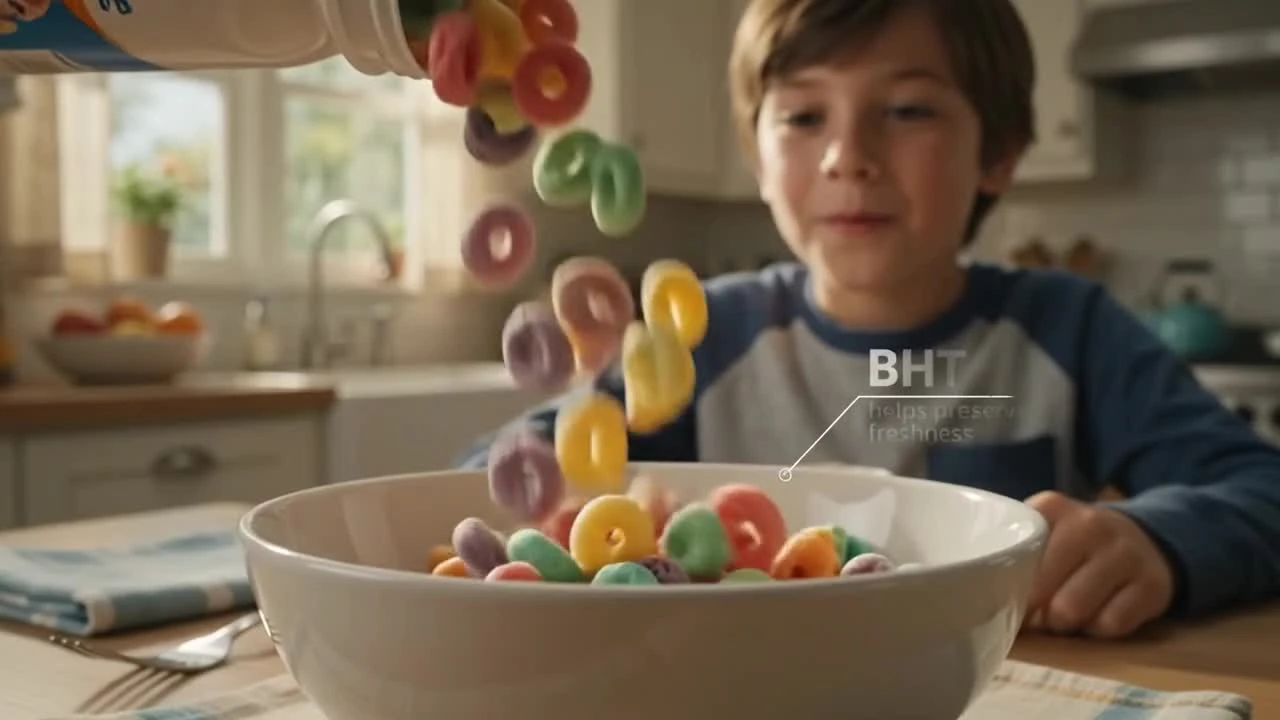
The preservative helps cereal, frozen pizza, and packaged snacks resist oxidation. Now the
FDA has opened a post-market reassessment of butylated hydroxytoluene, just as scientists and regulators confront a larger question: how long should yesterday's food-chemical decisions govern today's food supply?
Walk down the cereal aisle and the ingredient can be easy to miss.
BHT, short for butylated hydroxytoluene, may appear near the bottom of an ingredient list, doing a decidedly unglamorous job. It slows oxidation. Fats stay fresh longer. Flavors deteriorate more slowly. Shelf life improves.
That small technical advantage has helped keep BHT in portions of the American food supply for decades.
But something unusual is happening now.
On May 12, 2026, the U.S. Food and Drug Administration formally launched a post-market reassessment of BHT in human food and food-contact materials, seeking information on current uses, dietary exposure, and toxicity.
Then the agency extended the process.
On July 29, the FDA reopened its BHT public comment period after stakeholders said they needed additional time to assemble data. The new deadline is August 31, 2026.
That makes BHT more than another obscure ingredient debate.
It is now a live test of how the United States deals with chemicals that have been part of the food system for generations, even as toxicology, exposure patterns, and methods for evaluating chemical risk continue to change.
And the answer is not as simple as either “BHT causes cancer” or “BHT is FDA-approved, therefore there is nothing to worry about.”
The evidence is considerably messier.
The preservative hiding in familiar foods
BHT is a synthetic phenolic antioxidant. In food, its practical purpose is straightforward: it slows the oxidation that can make fats and oils rancid.
FDA's current ingredient database identifies BHT as an antioxidant and lists regulated uses under federal food-additive provisions.
The agency says BHT can be found in foods including breakfast cereals, frozen pizza, frozen meals, baking mixes, cookies, chewing gum and meat products.
Environmental Working Group (EWG) recently published assessment similarly points to cereal, frozen pizza, and chewing gum as common categories. Its Food Scores data identified BHT in 2,974 of 172,081 products added to the database between 2023 and 2025.
That figure needs context. EWG's database isn't a complete census of everything Americans eat, and the presence of an ingredient doesn't establish that exposure reaches a harmful dose.
Still, it demonstrates why the BHT question matters.
This isn't an exotic laboratory chemical with no plausible route into everyday life. It is an antioxidant deliberately used in foods people recognize.
And food is only part of the exposure picture. BHT is also used in cosmetics and other consumer and industrial products. A 2025 review of human exposure research reported the presence of BHT and its metabolites in biological samples, including serum, urine, and placenta, while emphasizing ongoing uncertainty about the health significance of those findings.
The question, then, isn't merely whether BHT can produce biological effects.
Almost any chemical can at a sufficiently high dose.
The more useful question is whether real-world exposure under current conditions of use poses a meaningful human health risk.
That is exactly the territory FDA is now revisiting.
What EWG says, and what the evidence actually establishes
EWG recommends avoiding or limiting foods containing BHT.
Its argument centers largely on animal toxicology and mechanistic evidence. The organization points to findings involving liver toxicity, tumor promotion, oxidative stress, and possible interference with endocrine signaling. It also notes that BHT has not been formally classified as a carcinogen.
Some of that concern has a scientific basis.
Older experimental research found that high-dose BHT exposure could produce substantial lung-cell proliferation in mice and promote adenoma formation following exposure to another carcinogenic agent.
But translating high-dose animal findings into the risk posed by the amount of BHT in someone's cereal is where the argument becomes much harder.
The European Food Safety Authority (EFSA) 's major evaluation of food additives reached a more nuanced conclusion. EFSA found BHT was not of concern for genotoxicity and concluded that observed carcinogenic effects appeared to have a threshold. It established an acceptable daily intake, or ADI, of 0.25 milligrams per kilogram of body weight per day.
That distinction matters.
A chemical producing tumors in an animal experiment does not automatically mean ordinary dietary exposure causes cancer in humans. Dose, metabolism, duration of exposure, species differences, and mechanism all matter.
EFSA nevertheless identified an exposure wrinkle that deserves attention.
Its assessment concluded that average estimated exposure among adults and children was generally below its ADI, but high-end exposure among children in some European countries could exceed it.
So the evidence does not comfortably fit either extreme.
BHT isn't established as a human carcinogen.
Neither does the existence of decades-old regulatory permission eliminate legitimate questions about current exposure, metabolites, vulnerable populations, or newer toxicological endpoints.
The oxidative-stress paradox
One of the stranger aspects of BHT is contained in its name and function.
It is an antioxidant.
Manufacturers use it because it interferes with oxidation in food.
Yet EWG cites research suggesting BHT or its metabolites may, under certain biological circumstances, contribute to oxidative stress.
That sounds contradictory until dose and metabolism enter the picture.
A substance's behavior in packaged fat isn't necessarily identical to what happens after it is absorbed and metabolized by a living organism. Researchers therefore distinguish among the parent compound, its metabolites, exposure levels, and biological settings.
Even here, the literature resists a clean villain narrative.
Recent experimental research has also documented antioxidant or protective effects from BHT in specific laboratory models. A 2025 cell study, for example, found BHT reduced markers of oxidative stress in cultured muscle cells exposed to hydrogen peroxide. Another 2025 animal study reported protective effects in a model of chemically induced hepatorenal injury.
Those experiments do not prove that eating BHT is beneficial.
They demonstrate something more important for interpreting food-chemical headlines: biological effects depend heavily on dose, model, route of exposure, and context.
“Oxidative stress” alone is not a diagnosis of consumer risk.
What about hormones?
The endocrine question is similarly unsettled.
Animal observations on thyroid physiology have raised concerns that BHT could interfere with endocrine signaling. But a toxicogenomics investigation designed specifically to test endocrine-disruption hypotheses found that neither BHT nor the analogs tested showed genomic signatures indicative of estrogen, androgen, thyroid receptor, or steroidogenesis activity in the assays used.
That doesn't close the case. It narrows it.
It also illustrates why ingredient safety cannot be reduced to a red-or-green score.
A toxicology study may identify a hazard at one dose. Another may test a different mechanism. Regulators then have to estimate exposure, identify uncertainty factors, and determine whether the conditions under which harm occurred are relevant to people who eat the substance.
Consumers encounter the final result as a six-point-font ingredient name.
Almost all of the reasoning disappears.
The larger investigation is about the system
BHT arrives at a particularly consequential moment for American food regulation.
Consumer Reports has spent the past several years documenting concerns about food additives and the uneven regulatory treatment of chemicals, including titanium dioxide, potassium bromate, synthetic dyes, and other ingredients. Its 2025 review noted that roughly half of foods purchased by Americans contain three or more additives, citing peer-reviewed research on U.S. grocery purchases.
The underlying 2023 study found increasing purchases of products containing technical food additives across many categories and reported a notable increase in baby-food purchases containing additives.
Another Consumer Reports investigation followed state efforts to restrict additives while highlighting longstanding weaknesses in the federal Generally Recognized as Safe, or GRAS, system.
The Guardian brought that issue back into focus in March 2026, reporting on an EWG analysis identifying more than 100 substances that companies had reportedly deemed GRAS without FDA review.
The underlying EWG analysis identified 111 such substances, with 49 appearing in products in USDA's Branded Foods Database. Crucially, EWG itself acknowledges that appearance on its list does not mean a substance is harmful. Its criticism concerns the lack of independent review and disclosure.
FDA's own description confirms the structural issue at the center of that investigation: under the current system, companies that conclude a use is GRAS may notify FDA, but notification has historically been voluntary.
That system is now changing.
On August 10, 2026, FDA proposed requiring GRAS notices for certain food-substance uses, a significant move toward mandatory disclosure.
BHT itself has its own regulatory history and shouldn't be conflated with every “secret GRAS” ingredient. But its reassessment belongs to the same larger story.
America is reconsidering how much confidence to place in old safety determinations, given that the science, food supply, and tools available to regulators have changed.
A pattern regulators have already confronted
There is recent precedent for revisiting long-established food chemicals.
In 2024, the FDA revoked authorization for brominated vegetable oil after new evidence, including studies conducted by the National Institutes of Health, no longer supported its safety under its intended conditions of use.
In January 2025, FDA revoked authorization for Red No. 3 in food and ingested drugs under the Delaney Clause after studies showed cancer in male laboratory rats, while also noting that the mechanism responsible for those tumors doesn't occur in humans in the same way.
These examples don't predict what FDA will decide about BHT.
They show that regulatory status is not supposed to be permanent scientific truth.
It is a decision based on the evidence available at a particular time, subject to reconsideration when better evidence arrives.
FDA now says it is building a more systematic post-market program precisely for that reason. BHT is among the chemicals selected for reassessment.
That may ultimately be the most consequential part of this story.
The dose problem consumers cannot see
Imagine two shoppers.
Both pick up cereals containing BHT.
One eats a serving occasionally. The other is a child who eats the cereal daily and also consumes packaged snacks, frozen foods, and chewing gum containing the same preservative.
The ingredient lists indicate that BHT is present.
They don't tell either shopper how many milligrams they are consuming.
They don't calculate exposure across products.
They don't compare that exposure with a health-based reference value.
They certainly don't account for body weight, age, or exposure from other sources.
This is the quiet weakness of ingredient transparency as it exists today.
Disclosure is useful. It isn't the same thing as interpretation.
A consumer can spend twenty minutes reading labels and still be unable to answer the question they actually care about:
What does this ingredient mean for me?
Where IngredientIQ changes the equation
That gap is where IngredientIQ's approach becomes relevant.
Conventional ingredient databases tend to answer a categorical question: Is this ingredient considered good or bad?
BHT demonstrates why that question can be scientifically inadequate.
A more defensible system needs to separate hazard from exposure, distinguish animal evidence from human evidence, identify regulatory disagreement, surface uncertainty, and update conclusions when authorities reopen a safety review.
Ideally, it should also recognize that the same ingredient may carry different relevance for different people.
IngredientIQ is being built around that harder problem: translating ingredient and regulatory data into context rather than flattening it into a universal verdict.
For BHT, that means a useful assessment shouldn't simply flash “toxic” because an animal experiment produced tumors at high doses. Nor should it display “safe” merely because the ingredient remains legally permitted.
It should show the tension.
FDA is reassessing it.
EWG recommends limiting it.
EFSA established an acceptable daily intake and found no genotoxic concern, while identifying possible high-end childhood exposure above its ADI in some scenarios.
The human evidence remains incomplete.
That is less emotionally satisfying than a red warning symbol.
It is also closer to the science.
What can consumers reasonably do now?
There is no evidence here supporting panic over a bowl of cereal.
There is also little reason consumers who prefer to minimize BHT exposure cannot do so.
BHT used as a direct food ingredient should appear in the ingredient list, enabling comparison shopping. Consumers concerned about exposure can compare similar cereals, snacks, frozen foods, and chewing gums and choose formulations without it.
More broadly, reducing reliance on heavily processed packaged foods will often reduce exposure to multiple technical additives at once. Consumer Reports similarly recommends emphasizing whole foods and comparing ingredient lists among otherwise similar products.
The important distinction is between precaution and certainty.
Choosing to reduce exposure while evidence is being reassessed is a personal risk-management decision.
Claiming BHT has been proven to cause cancer in people would go beyond the evidence.
The deadline that makes this story immediate
The FDA's BHT docket remains open until August 31, 2026.
The agency is specifically seeking information concerning dietary exposure, safety and toxicity, current uses and the regulatory basis for those uses.
What comes next could matter far beyond BHT.
If systematic post-market reviews become routine, chemicals that entered the food supply under older scientific assumptions may increasingly face reassessment under modern standards.
Some will probably survive that scrutiny.
Some may receive tighter restrictions.
Others could disappear.
That is how a functioning safety system should behave. Science rarely delivers a permanent answer on the first try.
For decades, shoppers looking at BHT on an ingredient label had remarkably little indication that a scientific argument sat behind those three letters.
Now the argument is happening in public.
For consumers
Don't treat ingredient lists as a chemistry exam you are expected to pass alone. Compare products, reduce an ingredient when the evidence gives you reason to prefer caution, and look for sources that distinguish established human risk from animal hazard and emerging research. Follow IngredientIQ's social channels for early access and continuing updates as FDA's BHT review develops.
For health professionals
BHT is a useful case study in risk communication. Patients may arrive with alarming claims drawn from animal studies or, conversely, assume legal permission means zero uncertainty. Neither interpretation captures the evidence. IngredientIQ's ongoing coverage is designed to surface regulatory status, exposure context, and evidence strength so those conversations can begin from the same factual baseline.
For journalists
The stronger BHT story isn't “common preservative causes cancer.” Current evidence doesn't support that headline. The more consequential investigation is why a decades-old ingredient is being reassessed now, what evidence FDA receives, how exposure estimates are constructed, and whether the new post-market program materially changes U.S. chemical oversight. Follow IngredientIQ for docket updates, source tracing, and ingredient-level regulatory changes.
Decoded is IngredientIQ's continuing investigation into the chemistry, regulation, and evidence behind everyday ingredients.
#BHT #ButylatedHydroxytoluene #FoodSafety #FoodAdditives #IngredientTransparency #FDA #FoodChemicals #ProcessedFoods #ConsumerHealth #Toxicology #RegulatoryScience #IngredientIQ