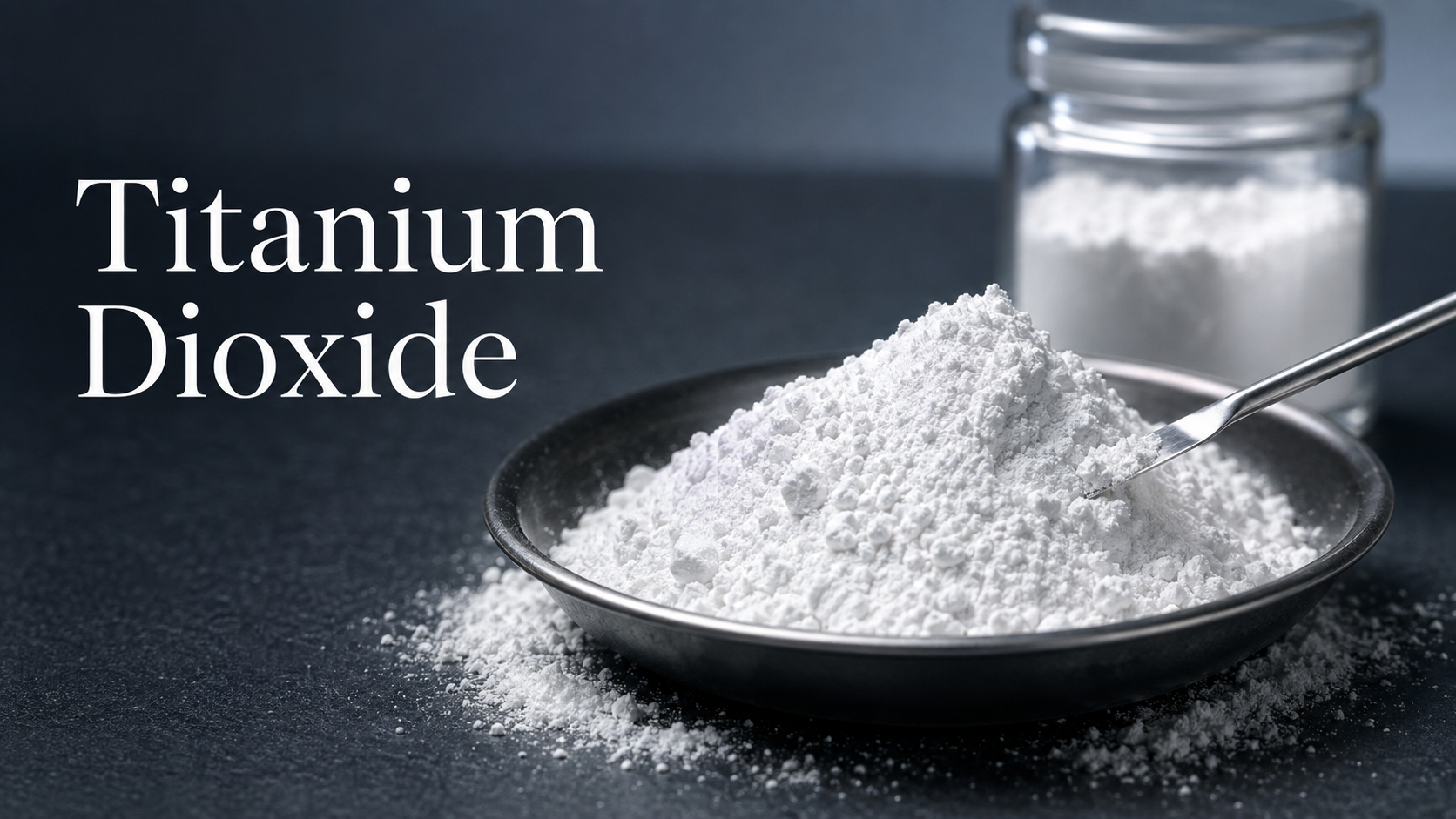
Titanium Dioxide Decoded: The White Pigment That Split the World's Food-Safety Authorities
A powdered doughnut is supposed to look harmless. Its icing is bright, smooth, and almost unnaturally white, a visual shorthand for sweetness and cleanliness. Yet that polished surface may owe something to titanium dioxide, a pigment now at the center of one of the sharpest disagreements in modern food regulation.
In the European Union, titanium dioxide, commonly identified as TiO₂ or E171, has been prohibited in food since 2022 because regulators could not rule out damage to genetic material. In the United States, manufacturers may still use it, provided the amount does not exceed 1 percent of the food's weight. A petition asking the FDA to revoke that authorization has remained under review since April 2023.
This isn't a simple story about Europe protecting consumers while America looks away. Canada, Australia, New Zealand, and a joint expert committee convened by the World Health Organization and the United Nations Foundation Food and Agriculture Organization have reviewed much of the same evidence and reached conclusions that are less restrictive than Europe’s.
That leaves consumers with an uncomfortable question: When respected regulators examine the same white powder and disagree about whether it belongs in food, what does "safe" actually mean?
A laboratory test of the American snack aisle
In 2026, Consumer Reports tested more than 120 samples representing 40 widely sold processed foods. The investigation covered additives and contaminants found in products such as candy, powdered drink mixes, pastries and brightly colored snacks. Roughly one-quarter of the products contained at least one additive tested above the investigators' selected health benchmark; when contaminants were included, the share rose to over one-third.
Titanium dioxide received unusual treatment in the analysis. Because the European Food Safety Authority had not identified an intake level at which genotoxic risk could be excluded, the investigators treated any detectable amount as exceeding their recommended limit. That decision reflects European Food Safety Authority (EFSA) a precautionary conclusion, but it should not be confused with proof that every detectable exposure causes harm.
A laboratory can determine whether titanium dioxide is present and estimate how much a product contains. It cannot, by itself, tell a parent whether one frosted pastry will damage a child's DNA. That judgment requires toxicology, exposure estimates, particle characterization, and assumptions about how findings in cells or animals translate to people.
Consumer Reports' investigation nevertheless exposed something consequential: American shoppers are being asked to make decisions in a scientific and regulatory environment that hasn't produced a shared definition of acceptable uncertainty.
What titanium dioxide does
Titanium dioxide is an inorganic pigment valued for its ability to scatter light. Food manufacturers have used it to make coatings, fillings, icings, chewing gum, and confectionery appear whiter or to make neighboring colors look more vivid.
Food-grade titanium dioxide isn't necessarily composed of uniformly large particles. Analyses have found that a portion of its particles may fall within the nanoscale range, where materials can behave differently due to their small size and large surface area relative to mass.
That particle distribution is central to the controversy. Older toxicology assumptions often treated titanium dioxide as a poorly absorbed, largely inert pigment. Newer research has asked whether very small particles can cross biological barriers, persist in tissue, promote oxidative stress, or interact with genetic material.
The debate, then, isn't only about the name printed on an ingredient panel. It is about the physical form of the substance, the testing methods used, and whether traditional food-additive assessments adequately capture particle-level effects.
Why Europe withdrew E171
EFSA reassessed titanium dioxide in 2021 after reviewing evidence that included studies involving nanoparticles, toxicokinetics, reproductive toxicity and genotoxicity.
The agency did not conclude that ordinary dietary exposure had been proven to cause cancer in humans. Its finding was narrower and, in regulatory terms, more disruptive: genotoxicity could not be ruled out. Because genetic damage can theoretically contribute to cancer and other adverse outcomes, EFSA said it could not establish a safe daily intake and no longer considered E171 safe as a food additive.
The European Commission subsequently withdrew authorization for titanium dioxide in food through Regulation (EU) 2022/63. The prohibition took effect in 2022 after a transition period.
This is often compressed into the phrase “Europe banned titanium dioxide because it causes cancer.” That wording goes further than the European evidence review.
The ban was driven principally by unresolved genotoxicity, not a finding that food-grade titanium dioxide had been demonstrated to cause cancer in people. EFSA’s logic was precautionary: when experts cannot rule out DNA-related harm and cannot define a reliably safe exposure level, continued authorization is difficult to justify.
That is different from proving danger. It is also different from proving safety.
The regulators that disagreed
In 2023, the joint FAO /WHO Expert Committee on Food Additives re-evaluated titanium dioxide. JECFA reviewed toxicokinetic, genotoxicity, reproductive, developmental and carcinogenicity evidence and retained an acceptable daily intake designation of “not specified,” a category used when the totality of evidence doesn't indicate a health hazard at levels necessary for the additive's intended function.
Health Canada likewise concluded that available evidence did not show a health concern from food-grade titanium dioxide at existing dietary exposure levels. Its assessment challenged whether some genotoxicity studies were sufficiently reliable or applicable to the food-grade material consumers actually ingest.
Food Standards Australia New Zealand reached a similar position. Its review found no evidence indicating that dietary exposure to food-grade titanium dioxide posed a human-health concern and noted that other authorities had not accepted EFSA’s interpretation of the evidence.These conclusions don’t erase EFSA’s concerns. They reveal how regulatory outcomes depend on more than a stack of studies.
Authorities can differ over:
- which laboratory methods are reliable;
- whether the tested material resembles commercial food-grade TiO₂;
- how much weight to give positive results from cell studies;
- whether oral absorption is high enough to create meaningful systemic exposure;
- and what level of uncertainty justifies removing an additive with no nutritional function.
One regulator may ask, “Has harm been demonstrated at realistic exposure?” Another may ask, “Can genetic harm be confidently excluded?” Those questions sound similar, but they place the burden of proof in different locations.
The American rule is still standing
FDA regulations permit titanium dioxide as a food color, provided its quantity doesn’t exceed 1 percent by weight of the finished food.
That ceiling is a legal condition of use, not a personalized safety threshold. It doesn’t tell a consumer how exposure accumulates across multiple products, how particle size varies among suppliers or whether a child with a diet high in decorated sweets experiences a meaningfully different exposure pattern from an adult who rarely eats them.
In April 2023, the Environmental Defense Fund Center for Environmental Health, the Center for Food Safety, the Center for Science in the Public Interest, and the Environmental Working Group submitted a petition requesting that the FDA repeal the titanium dioxide food-color regulation. As of the FDA's May 28, 2026 petition inventory, the request remained under review.
The petition's unresolved status captures the broader regulatory lag. Europe acted in 2022. JECFA delivered a contrary international assessment in 2023. Consumer testing and public pressure have continued. Yet the operative U.S. rule still rests on a numerical maximum that doesn’t resolve the scientific dispute now troubling consumers.
The word "carcinogen" needs context
Titanium dioxide is frequently described online as a possible carcinogen. That statement usually traces to evaluations of inhaled particles, particularly occupational exposure to airborne dust.
The IARC - International Agency for Research on Cancer / World Health Organization classified titanium dioxide as possibly carcinogenic to humans, based largely on evidence of respiratory tumors in rats exposed to high concentrations by inhalation. The route of exposure matters. Breathing concentrated particles into the lungs isn’t equivalent to eating a small quantity dispersed through icing or candy.
Canada’s assessment similarly noted lung tumors in animal inhalation studies but concluded that those findings occurred under lung-overload conditions and weren’t directly relevant to general-population exposure.
None of that makes the food debate irrelevant. It means “potential carcinogenicity” should not be presented without explaining whether the evidence concerns inhalation, ingestion, animal studies, genotoxicity or established human disease.
Poor risk communication collapses these categories. Responsible ingredient transparency keeps them separate.
An exposure problem disguised as a label problem
A consumer can sometimes avoid titanium dioxide by looking for “titanium dioxide” or “TiO₂” in an ingredient list. But label reading alone has limits.
Ingredient panels tell shoppers what was intentionally added. They rarely explain particle distribution, concentration per serving, supplier specifications, or how often the same substance appears across a person's diet. A parent might find titanium dioxide in cake decorations, chewing gum, and a powdered dessert without knowing whether the combined exposure is trivial or worth reducing.
The 1 percent U.S. limit is even less useful at the point of purchase. Manufacturers generally aren't required to print the pigment's concentration on the package. Two products can list the same additive while containing very different amounts.
This is where conventional ingredient apps often stop: the additive is flagged red, yellow, or green, and the consumer is left with a verdict.
IngredientIQ ’s more defensible role is not to declare that every product containing TiO₂ is toxic. It is to make the disagreement visible. A useful system should distinguish EFSA’s unresolved genotoxicity concern from JECFA’s and Health Canada’s more permissive conclusions, identify the regulatory jurisdiction, show the purpose of the additive, and account for the user’s likely exposure pattern.For a family that rarely buys confectionery, the practical significance may be small. For a child who routinely consumes several foods containing the pigment, a precautionary recommendation may carry more weight. A person’s age, dietary frequency, medical circumstances, and tolerance for uncertainty all matter.
That is what AI-driven personalization should do in food safety: organize evidence around the individual without pretending the algorithm has settled a scientific argument that regulators themselves haven't resolved.
The ethical problem with cosmetic additives
Titanium dioxide doesn't prevent botulism. It doesn't supply a vitamin or preserve a staple food during transport. In many products, its function is visual.
That changes the ethical calculation.
When an additive provides a major safety or nutritional benefit, regulators may reasonably tolerate some uncertainty. When its primary job is to make a coating look brighter, the justification for accepting unresolved biological questions becomes harder to defend.
Manufacturers already reformulate products for different markets. A candy or pastry sold without E171 in Europe demonstrates that the pigment isn’t always technically indispensable. The question is no longer whether food companies can remove it. It is why some consumers receive a precautionary formulation while others receive one permitted under an older national rule.
The answer may involve cost, supply chains, product appearance and regulatory compliance. None of those explanations gives shoppers the information needed to decide whether a cosmetic benefit is worth an uncertain exposure.
What can consumers reasonably do now?
There is no evidence that eating one TiO₂-containing sweet constitutes a medical emergency. The scientific dispute concerns uncertainty, repeated exposure and whether available testing can confidently exclude genotoxic effects.
Consumers who prefer the European precautionary approach can look for titanium dioxide, TiO₂, E171 or INS 171 on ingredient lists and choose alternatives without whitening pigments. Reducing heavily processed sweets and decorative baked goods may also lower exposure while addressing more established concerns, such as excess added sugar.
Parents shouldn’t assume that every white food contains the pigment, or that every titanium dioxide exposure is equivalent. The compound is used in products beyond food, and risks associated with inhaling fine occupational dust shouldn’t be automatically transferred to dietary exposure.
The most honest conclusion is less dramatic than the social-media version and more troubling than a regulatory reassurance: scientists haven’t reached a common answer, and American consumers are being given very little context for navigating that disagreement.
The accountability test
Titanium dioxide is a case study in what happens when ingredient regulation crosses the frontier of nanoscience.
Europe concluded that uncertainty itself was sufficient reason to remove the pigment from food. Other regulators concluded that the evidence didn’t demonstrate a dietary risk under existing uses. The FDA has continued to permit it while reviewing a petition filed more than three years ago.
IngredientIQ’s credibility will depend on resisting the temptation to turn this dispute into a simplistic danger score. The public needs the studies, the regulatory reasoning, the exposure context, and the unresolved questions in one place.
A white pigment shouldn't become a black-and-white story simply because that is easier to sell.
What happens next
For consumers: Search IngredientIQ's ingredient intelligence before buying highly decorated candies, pastries, and snack foods. Compare products, check how often the same additive appears in your household's diet, and decide whether a precautionary alternative fits your family. For health professionals: Use the titanium dioxide dispute as a risk-communication case, especially when patients arrive with alarming claims about DNA damage or cancer. Distinguish hazard from exposure, ingestion from inhalation, and regulatory uncertainty from proven clinical harm. For journalists: Press the FDA for the evidence, timetable, and decision criteria governing the pending petition. Ask manufacturers whether U.S. formulations differ from European versions, and request concentration and particle-characterization data rather than accepting a statement that a product “meets all applicable regulations.”Follow IngredientIQ's social platforms for early access to ingredient investigations, regulatory updates, and continuing coverage of the substances hidden behind ordinary package labels.
#TitaniumDioxide #FoodAdditives #IngredientTransparency #FoodSafety #ConsumerHealth #E171 #ProcessedFoods #Toxicology #RegulatoryScience #PublicHealth #CleanLabel #IngredientIQ