Sweetness Decoded | The Sweetener Boom Outran the Safety System
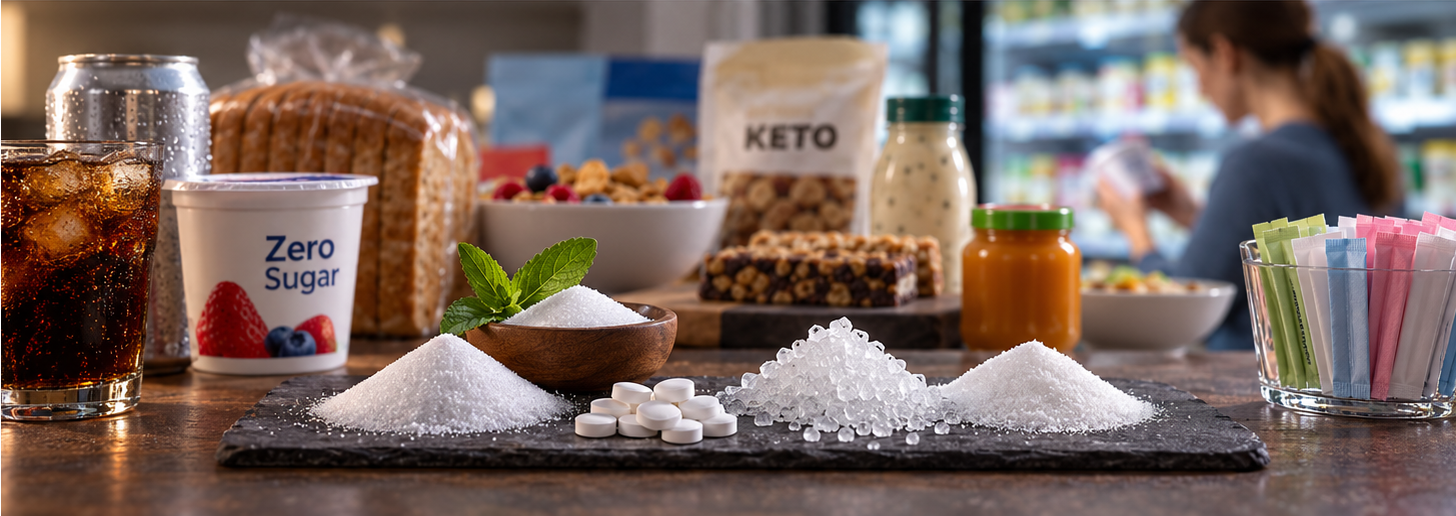
A decade ago, artificial and low-calorie sweeteners still carried a fairly obvious identity. They lived in diet soda, tabletop packets, and the occasional sugar-free candy aisle. Today, they can turn up in yogurt, bread, cereal, protein bars, salad dressing, baby food, and products marketed as "keto," "zero sugar," or simply healthier.
The change happened faster than most consumers noticed, and faster than the U.S. system for reassessing food ingredients could comfortably keep pace with.
An Environmental Working Group analysis of more than 80,000 products in its Food Scores database found that reported sweetener use rose sharply between 2013 and 2022, including increases of more than 600 percent in baby foods, more than 400 percent in beverages and more than 700 percent in diet and nutrition products. EWG also concluded that only 10 of the 44 sweeteners it examined had undergone what it characterized as a thorough FDA safety review before entering the food supply.
Those numbers come from EWG, not a federal consumption survey, so they shouldn't be read as proof that Americans consumed seven times as much sweetener. They do capture something regulators now acknowledge more explicitly: the chemical landscape of the American food supply has changed, while the government's system for continuously reviewing ingredients already on the market has historically been fragmented.
That gap has become difficult to ignore.
In May 2026, the FDA finalized a systematic post-market program for chemicals already in food. Then, on August 10, the agency proposed an even more consequential change: manufacturers relying on the “generally recognized as safe,” or GRAS, pathway would, for many uses, have to notify FDA rather than quietly reach a GRAS conclusion without telling the agency. The current notification system remains voluntary while that proposal moves through rulemaking.
That timing matters.
The regulatory system is beginning to move just as new research is complicating the assumption that replacing sugar with something sweeter and lower in calories is automatically an uncomplicated health trade.
The question is no longer simply: Is sugar bad?
It's becoming: What exactly did we replace it with, how much are we consuming, and when was anyone last required to look?
The yogurt problem
Picture a parent standing in front of a refrigerated grocery case.
One yogurt contains 12 grams of added sugar. Another says "zero sugar." A third advertises "keto friendly." The front panels seem to offer a simple hierarchy: less sugar, healthier product.
Turn the packages around.
The second may contain sucralose. The third could use erythritol, stevia, allulose, or a blend of several sweeteners designed to replicate the sweetness and texture sugar once provided.
Nothing about that ingredient list necessarily means the food is dangerous. That distinction is essential.
But the shopper has crossed from a familiar nutritional calculation into several separate scientific questions without being told so.
Does the ingredient have an FDA-approved acceptable intake? Was it reviewed through the food-additive petition system, or did its manufacturer rely on GRAS? Has the pattern of use expanded since the original safety evaluation? Is the relevant evidence about cancer, cardiovascular disease, glucose control, gastrointestinal effects, the microbiome, or something else entirely? And does the evidence concern the amount actually present in this particular product?
Most labels can't answer any of those questions.
Even regulators often aren't working from a single continuously updated answer.
How "generally recognized as safe" became the hinge
Congress created the GRAS concept in 1958 largely so ordinary substances whose safety was already broadly accepted, such as salt and vinegar, would not require the same premarket approval process as novel food additives.
Over time, GRAS became far more consequential.
Under the current framework, a company can conclude that a substance is GRAS for a particular use. FDA strongly encourages companies to submit those conclusions through its GRAS notification program, but notification remains voluntary today. The FDA itself says a manufacturer may reach a GRAS conclusion without notifying the agency.
That distinction is easily lost in ordinary language.
A product can contain an ingredient legally marketed on the basis of GRAS without that ingredient having gone through the same premarket approval route people commonly imagine when they hear that something is “FDA approved.”
KFF Health News examined this system in a 2025 investigation and described an American food supply in which companies have historically been able to make some safety determinations without first informing FDA. Its reporting captured the central accountability problem: consumers often assume an ingredient's presence on a supermarket shelf means the government independently reviewed it before sale. That isn't always how the law works.FDA is now attempting to narrow that information gap.
Its August 2026 proposed rule would convert the voluntary GRAS notification system into a mandatory one for many uses. The agency says the change could give regulators and the public greater visibility into substances entering food and allow the FDA to more efficiently determine whether a substance should instead be regulated as a food additive.
It is a substantial proposal.
It is not yet a final rule.
And even mandatory notification would not transform every GRAS substance into a conventional FDA-approved food additive. The legal pathways remain different.
That nuance is precisely why “Is this ingredient approved?” is often the wrong question.
A better one is: What evidence supports this use, who evaluated it, under which regulatory pathway, and what has changed since that evaluation?
A safety decision can age
EWG's 2023 analysis highlighted a second problem. Some sweeteners have regulatory histories stretching back decades.
Its review listed FDA actions on sorbitol, mannitol, xylitol, and several other ingredients dating back to the 1970s. EWG argued that significant changes in how often these substances appear in processed foods should prompt a fresh review.
The broader principle is difficult to dismiss even where scientists disagree about an individual sweetener.
Toxicology does not freeze when a regulatory decision is made.
Exposure changes. Manufacturing changes. Researchers develop better biomarkers. Diseases once studied crudely can be measured with greater precision. A substance used sparingly in one category can migrate into dozens of foods. Combinations can change. So can the population consuming them.
FDA itself now describes post-market review as a process in which new information about hazards, use and exposure can trigger reassessment. Its finalized 2026 framework includes signal identification, prioritization, scientific assessment and risk management.
The agency's changing policy is an implicit acknowledgment of something fundamental: a safety decision is not a lifetime warranty, detached from dose, exposure, and subsequent evidence.
This is where the sweetener story becomes more interesting.
Because while regulation was catching up with the idea of systematic reassessment, researchers were producing signals that did not fit neatly into the old "sugar versus no calories" debate.
WHO changed the question?
In May 2023, the World Health Organization advised against using non-sugar sweeteners as a strategy for long-term weight control or prevention of noncommunicable disease.
The recommendation covered sweeteners including aspartame, acesulfame K, saccharin, sucralose and stevia derivatives.
But WHO was careful about what it was, and wasn't, saying.
Its guideline concluded that replacing free sugar with non-sugar sweeteners did not appear to produce a long-term benefit in reducing body fat. The review also found observational associations between long-term sweetener use and outcomes including type 2 diabetes, cardiovascular disease and mortality. WHO classified the recommendation as conditional because those associations may partly reflect confounding. People already at elevated metabolic risk, for instance, may be more likely to choose diet products in the first place.
The guideline was also explicitly not a toxicological safety assessment of individual sweeteners.
That point is critical.
WHO did not declare that all non-sugar sweeteners are toxic. It said the evidence did not support relying on them for long-term weight control and suggested reducing the overall sweetness of the diet instead.
The public message had shifted from "Which sweetener lets me keep sweetness without the calories?" to a less convenient question:
Why does everything need to taste this sweet in the first place?Then came aspartame
Two months later, one of the world's most familiar artificial sweeteners moved into an even more confusing regulatory spotlight.
In July 2023, the IARC - International Agency for Research on Cancer / World Health Organization classified aspartame as “possibly carcinogenic to humans,” Group 2B, citing limited evidence for carcinogenicity in people. At the same time, the Joint FAO/WHO Expert Committee on Food Additives reaffirmed its acceptable daily intake of 40 milligrams per kilogram of body weight.
Both conclusions can be true because they answer different questions.
IARC assesses hazard: can a substance cause cancer under some circumstances?
JECFA evaluates risk at actual exposure levels: how much can people consume before the evidence indicates an unacceptable risk?
Reuters' reporting on the decision, republished by The Guardian US , captured the apparent contradiction. Aspartame could be categorized as a possible carcinogenic hazard while the existing intake limit remained unchanged.
A headline that says "possible carcinogen" is easy to understand.
A two-track hazard-versus-risk assessment is not.
For consumers, this distinction matters more than rhetoric. Group 2B is not equivalent to a finding that ordinary consumption causes cancer. IARC itself emphasized that the human evidence was limited, while JECFA retained the established acceptable daily intake.
The episode nevertheless exposed the weakness of treating a label as the end of the inquiry.
"Aspartame" is one ingredient name. The meaningful questions concern dose, frequency, total dietary exposure, the user's health context, and the quality of evidence behind each endpoint.
That is a much harder interface to fit on a package.
Erythritol produced a different kind of signal
The erythritol story was more mechanistic.
A 2023 Nature Medicine study began with people undergoing cardiac evaluation. Researchers found that higher circulating erythritol levels were associated with higher three-year rates of major cardiovascular events. In independent U.S. and European cohorts, people with the highest measured levels had significantly higher event risk than those with the lowest levels.
The researchers went further.
Laboratory experiments suggested erythritol increased platelet reactivity and thrombosis. In a small intervention involving eight healthy volunteers, ingestion of erythritol produced a large, sustained rise in blood erythritol levels.
STAT 's coverage at the time was appropriately cautious. Outside scientists noted that the observational portion could not prove that dietary erythritol caused heart attacks or strokes. People with underlying metabolic disease can also produce erythritol endogenously, complicating causal interpretation.Then, in 2024, the same research group conducted another intervention.
Twenty healthy volunteers consumed either 30 grams of erythritol or 30 grams of glucose. After erythritol ingestion, researchers reported substantially increased circulating erythritol and greater platelet reactivity. The glucose group did not show the same platelet changes. The experiment was small and measured short-term biological effects, not actual heart attacks or strokes. It nevertheless added a controlled human signal to the earlier observational findings.
This is exactly the type of evidence post-market systems are supposed to evaluate.
Not because one study settles safety.
Because one study may change the question that needs to be answered next.
Xylitol followed
In 2024, researchers reported a strikingly similar signal for xylitol.
The European Heart Journal study (European Heart Journal) analyzed data from more than 3,000 people across the discovery and validation cohorts. Higher circulating xylitol was associated with increased three-year risk of major cardiovascular events. In mechanistic experiments, xylitol enhanced platelet responsiveness and thrombosis. A small human intervention also found increased platelet activity after participants consumed a xylitol-sweetened drink.
Again, association is not causation.
Again, a short-term platelet experiment is not a cardiovascular-outcomes trial.
And again, the result doesn't justify telling people that a stick of xylitol gum will cause a heart attack.
The more defensible interpretation is narrower, but consequential: two widely used sugar alcohols have now generated cardiovascular signals substantial enough that their investigators have called for further long-term safety research.
That is not a verdict.
It is a reason to keep the file open.
The label is becoming an exposure map
Consumer Reports highlighted another part of the problem in 2024: sugar substitutes increasingly appear in foods where shoppers may not expect them, including ketchup, breads and cereals. Words such as "light," "zero sugar added," or "keto" can signal their presence, but finding them often still requires reading the ingredient list.
Now consider what happens across an entire day.
A person drinks a stevia-sweetened coffee beverage at breakfast.
Their protein bar contains erythritol and monk fruit.
Their yogurt uses sucralose.
Their afternoon drink contains acesulfame potassium.
Dinner includes a reduced-sugar sauce.
They chew xylitol gum afterward.
Each product can be considered separately under its intended conditions of use. The consumer, however, eats the diet, not the regulatory dossier.
That difference may become one of the defining problems of food transparency in the next decade.
Risk is not simply an ingredient property. It is a relationship among hazard, dose, timing, frequency, metabolism, medical context and cumulative exposure.
And a package can tell you almost none of that.
The numbers EWG found deserve scrutiny, not panic
EWG's Food Scores analysis reported especially large percentage increases in the appearance of sweeteners between 2013 and 2022. Synthetic sweetener appearances reportedly rose more than 600 percent in beverages, more than 800 percent in frozen foods, and more than 900 percent in diet and nutrition products.
Those are database observations, not direct measurements of grams consumed.
A 900 percent increase from a small baseline can sound more dramatic than its absolute magnitude. Reformulation and expansion of the Food Scores product universe can also complicate decade-long comparisons.
That doesn't make the analysis useless.
It means its strongest contribution is as a signal of a change in product formulation, not as a standalone epidemiological measure.
Pair that signal with Consumer Reports' documentation of sugar substitutes appearing in unexpected categories, WHO's shift away from recommending them for weight control, emerging cardiovascular research on sugar alcohols, and FDA's decision to build a systematic post-market reassessment framework.
A pattern begins to form.
Not “sweeteners are poisoning us.”
Something less sensational and harder to solve:
The way sweeteners are used in the food supply has evolved faster than the systems consumers use to understand their exposure and the systems regulators historically used to revisit old safety assumptions. image-shrink</em>1000_1488/B56aBqIKg3IsAI-/0/1788486925786?e=1790208000&v=beta&t=ID50vZC8CLDjbAUR5219sgw71MThfzeYrcV-uyrmXEo" alt="Article content" loading="lazy">
A regulatory vacuum is beginning to fill, but slowly
Calling the current U.S. system a complete “regulatory vacuum” is no longer accurate.
FDA has moved.
The agency finalized its new systematic post-market assessment process in May 2026. It has launched or prioritized reassessments for several food chemicals, including BHA, BHT, and azodicarbonamide. Its August 2026 GRAS proposal would require notification for many GRAS conclusions that can currently remain undisclosed to the FDA.
But two gaps remain.
First, a framework is not the same thing as completed reassessments. FDA oversees an enormous universe of food ingredients, contaminants, packaging substances and additives. Prioritization necessarily means some substances wait.
Second, the proposed GRAS reform mainly addresses visibility and oversight at market entry. It does not magically answer every question about cumulative exposure or decades of changing dietary use.
The government's challenge is institutional.
The consumer's challenge is immediate.
Dinner is tonight.
Why IngredientIQ matters in that gap
The useful response to uncertain food science is not a universal red flag.
It is better resolution.
IngredientIQ's role is to shift the question from “Is this ingredient good or bad?” toward something closer to how toxicologists and clinicians actually think: “What is the substance?” What evidence exists? How strong is it? What dose and exposure were studied? Which regulatory pathway applies? Has anything changed? And does any of that matter differently for this particular person?
That distinction is especially important with sweeteners.
A person managing diabetes may reasonably prioritize glycemic control differently from someone with cardiovascular disease. A parent assessing a child's daily exposure faces another calculation. Someone consuming one diet beverage each week is not in the same exposure category as someone stacking sweetened protein powders, drinks, bars, and desserts every day.
Ingredient transparency without context can become another form of noise.
Personalization without transparent sourcing can become a black box.
The defensible middle is an ingredient-intelligence system that connects the label to current regulatory status and the underlying evidence, while making uncertainty visible rather than erasing it.
That is the standard consumers should demand from any tool making sense of food chemistry.
The uncomfortable question
For decades, the food industry had a straightforward commercial incentive: preserve sweetness while reducing sugar, calories, or both.
Consumers asked for it.
Public-health messaging often pushed in the same direction as accumulating evidence about excess added sugar.
Food science delivered.
Now the second-order consequences are arriving.
What happens when dozens of individually permitted formulations collectively reshape population exposure?
What happens when a substance once used occasionally becomes a staple of “healthy” processed food?
What happens when a cardiovascular signal emerges after an ingredient has already spent years spreading through the supermarket?
And who is responsible for connecting those dots?
Manufacturers know their formulations.
Regulators know legal pathways and toxicological dossiers.
Researchers know individual studies.
Clinicians know their patients.
Consumers sometimes know what they ate.
Almost nobody sees the whole map.
That may be the real sweetener problem.
Not sweetness itself.
Fragmented knowledge.
What to do now
For consumers, the evidence does not support panicking over every packet of stevia or throwing away every product containing erythritol. It does support reading past "zero sugar," noticing how many sweetened products accumulate across the day, and treating sugar substitutes as ingredients rather than nutritional invisibility cloaks. IngredientIQ can help turn unfamiliar names into a traceable record of evidence rather than a binary verdict.
For health professionals, the emerging literature makes dietary history more granular. Asking whether a patient drinks "diet soda" may no longer adequately capture exposure. Protein products, supplements, yogurt, gums, sauces, and keto foods can also matter. When evidence is preliminary, say so. When dose data are absent from the labels, say so.
For journalists, the richest story is no longer another "Is aspartame safe?” headline. Follow the regulatory pathways. Pull the GRAS notices. Compare historical intended uses with current product proliferation. Ask what post-market signals FDA is prioritizing, which are pending, and why. The most consequential findings may be hiding in administrative records rather than nutrition slogans.
IngredientIQ will continue to track those records, the emerging science, and the widening gap between what appears on the label and what a consumer actually needs to know.
Follow IngredientIQ's social channels for early access, regulatory updates, and continuing editions of Decoded.
#FoodSafety #IngredientTransparency #ArtificialSweeteners #FoodAdditives #NutritionScience #PublicHealth #GRAS #UltraProcessedFoods #ConsumerHealth #FoodChemistry #RegulatoryScience #IngredientIQ #Dietsoda #Zerosugar